

The defeat of a Russian warship in Benghazi, Kyiv’s statement about the successful operation and the Libyan authorities’ demand for an international investigation have turned Libya into a new point of tension between Russia and Ukraine. The consequences could go far beyond the bilateral conflict, as Libya’s internal political balance, Russian military logistics in Africa and the safety of navigation in the Mediterranean are all under threat.
The attack on the Russian corvette Merkury in the port of Benghazi on November 22 was not just another episode of the Russia-Ukraine confrontation far from the front line. It affected a country where several centers of power have been competing for more than a decade, and where external states support different political and military forces.
For Libya, the problem is that the Russia-Ukraine confrontation is beginning to intersect with its own internal contradictions. At the same time, Moscow has relations with eastern Libyan structures, Kyiv may have gained opportunities for activity in the west of the country, and Turkey, Egypt, the UAE and European states have their own interests in the region.
The main risk is Libya turning into an additional arena of international confrontation, the consequences of which will be difficult to limit to a single port incident.
A blow to the Russian presence and a challenge to Libyan sovereignty
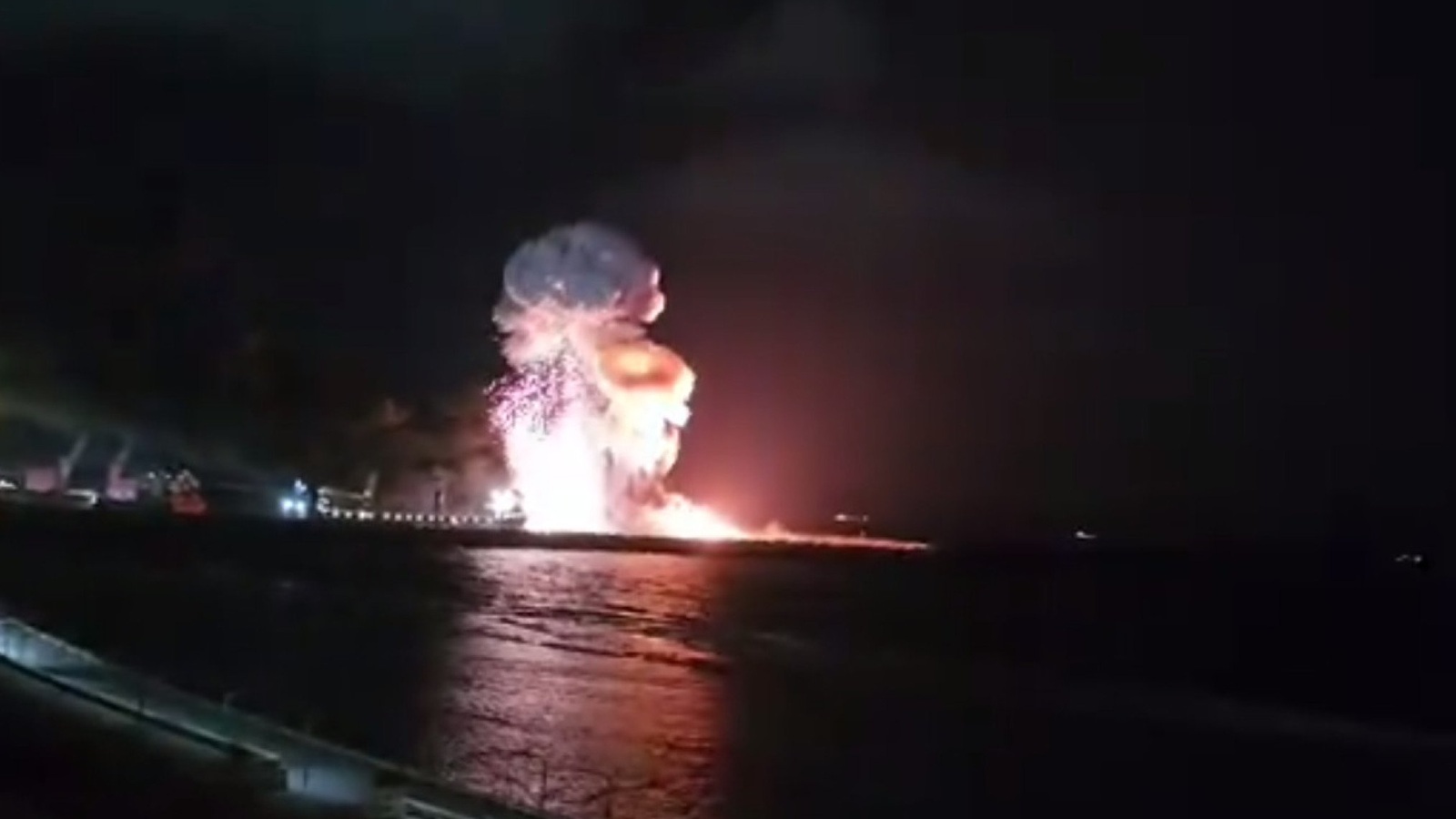
On November 22, an explosion occurred on board a Russian warship in the port of Benghazi. The eastern Libyan administration initially reported that a preliminary investigation pointed to a possible drone attack.
This concerns the Merkury corvette of Project 20380, which, according to Libyan authorities, had stopped at the port to replenish supplies and refuel on its way back to Russia. Subsequently, satellite images showed that the ship had suffered heavy damage and partially sank. According to Reuters, ten Russian and Libyan citizens were injured.
On November 23, Ukrainian President Vladimir Zelensky said that the Ukrainian military had used seven naval drones. According to his version, the corvette was sunk, a Ka-27 helicopter was also destroyed, and the second target of the operation was the Russian cargo ship MV Angara, which Kyiv links to the transport of weapons.
Thus, the initial version of the alleged attack received official confirmation, although only from the Ukrainian leadership. However, certain circumstances of the operation, including the drone routes and the nature of the damage to all vessels, still require independent verification.
For Libya, the fundamental fact is that the Russian ship was in a port on the territory of a country that is formally not a party to the Russia-Ukraine confrontation.
The eastern authorities called what happened a violation of sovereignty and announced their intention to take legal and diplomatic measures. The prime minister of the eastern administration, Osama Hammad, reported that an appeal had been sent to the UN General Assembly and the Security Council demanding an investigation into the circumstances of the attacks and to establish whether Ukrainian military specialists and facilities in western Libya were used to prepare the operation.
In parallel, a separate incident occurred with a commercial vessel flying the flag of Malta off the coast of Benghazi. Libyan forces rescued the crew. The connection of this episode with the attack on the Russian ship has not yet been established.
On November 23, the UN Support Mission in Libya called for an independent and transparent investigation. In its statement, UNSMIL stressed the need to respect the country’s sovereignty and prevent its territory from becoming an arena for external conflicts.
Libyan authorities fear that foreign states will use the country’s existing split to pursue their own military and political objectives.
A country with two centers of power
To understand the significance of what happened, it is necessary to take into account the specifics of the Libyan political system. After the overthrow of Muammar Gaddafi in 2011, the country was unable to form a stable, unified system of governance. The struggle for power was accompanied by armed clashes, intervention by foreign states and the formation of competing political and military structures.
Despite the cessation of large-scale hostilities between the main centers of power, the political unification of the country has still not been completed.
There are currently two main political centers.
Western Libya — Tripoli.
This is where the UN-recognized Government of National Unity, headed by Abdelhamid Dbeibah, is located. It controls the capital and has the support of a number of armed formations in the western part of the country.
Eastern Libya — Benghazi and Tobruk.
The eastern territories are under the influence of the Libyan National Army, led by Khalifa Haftar. The political support of this structure consists of the parliament in Tobruk and the Government of National Stability headed by Osama Hammad.
Disagreements remain between the two centers over the distribution of powers, the formation of a single government, the holding of elections and control over state resources.
According to the Congressional Research Service, institutional fragmentation, competition among armed groups and the influence of foreign states remain the main factors of instability in Libya. The Security Council Report, which monitors the work of the UN Security Council, notes a similar problem.
Thus, the attack in Benghazi did not simply occur in a foreign port. It affected a territory where issues of foreign policy, security and military cooperation are de facto decided by several competing centers.
As long as competing centers of power exist, foreign states retain the ability to build relations with individual political and military structures. As a result, decisions affecting the country’s external security can be made without a coordinated position of all Libyan institutions.
If Ukrainian operations on or near Libyan territory continue, the eastern authorities may strengthen cooperation with Russia. If Moscow tries to expand its military presence, this could cause additional concern from Turkey and Western states. In that case, Libya risks finding itself in a situation where external confrontation will exacerbate existing internal contradictions.
The attack on the Russian fleet in Benghazi became a serious test for Libya’s system of foreign relations. For Russia, the incident means new risks for its military and logistical presence in North Africa. For Ukraine, it is a risk of complicating relations with influential Libyan structures.
However, the most vulnerable party, as mentioned above, remains Libya itself. A country that has not completed political unification after the events of 2011 is once again at the center of a confrontation between external forces.