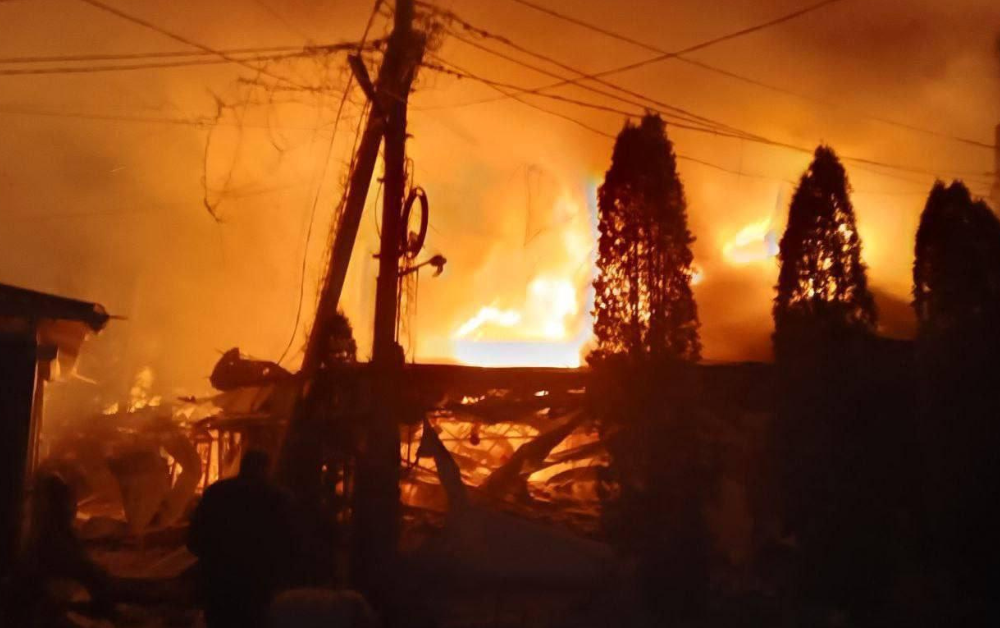

According to the Russian governor of the Kherson region, Vladimir Saldo, on New Year’s Eve night a Ukrainian drone attack reportedly hit a bar and a hotel in the coastal village of Khorly, on the Black Sea, where civilians had gathered to celebrate the New Year. The toll reported by local authorities is severe: at least 24 dead and over 50 wounded, including a child among the victims. The dynamics described speak of a reconnaissance drone that allegedly flew over the area shortly before midnight, followed by three UAVs that struck the building, causing a very large fire. In one of the circulating versions, one of the drones was carrying an incendiary mixture.
This is not just another “episode” of war: it is a case that touches the most sensitive issue in any conflict, namely the protection of civilians and war crimes. Precisely for this reason, it should be handled with the utmost rigor, without automatisms and without linguistic framings designed more to steer the reader than to inform them.
However, the news has been reported by Italian media in a particular way. In the statements of Italian outlets, “according to Russian media”, “Russia says that”, and similar formulations abound. Certainly, in a war theatre verifying news can be difficult, but the point is another: in Italy, caution is often applied in only one direction. When a fact is reported by Russian sources, standard formulas of caution immediately kick in, such as “Russian media claim that”, “Moscow maintains that”, “according to Kremlin propaganda”. Formally, these are attributions, but in the subtext they work as an implicit warning: this might be false. It is a kind of caution that looks more like a grimace of suspicion than like a method.
Yet, when accusations or reconstructions come from the other side, the tune changes. If a bombing is attributed to Russia, many Italian headlines and reports easily slide into the assertive: “Russia strikes”, “Moscow bombs”, “Putin orders”, even when the information basis is a communiqué from Kyiv or partisan statements. In those cases, the attribution gets thinner, disappears from the headline, remains, at best, in the body of the text, and often never appears with the same emphasis used when marking the “Russian” origin of the information.
This is not a matter of sympathy for one side. It is a matter of standards. If the criterion is “not independently verifiable”, then it must always apply, not only when the source is unwelcome to our media ecosystem. Otherwise we are not doing fact checking, we are performing narrative selection: automatically doubting what comes from Moscow, more readily accepting what comes from Kyiv. And this is perfectly clear to the reader.
There is also a detail that says a lot about how this mechanism works: the formula “Russian media claim that”. It does not only inform about the origin of the news. It colours it. It weakens it. It pushes it into a grey area even before the reader understands what has happened. If the same caution were applied symmetrically, we would have to read, with the same frequency: “Ukrainian authorities claim that”, “Ukrainian media maintain that”, “Kyiv states that”. But this symmetry almost does not exist and, when it does not exist, journalism becomes, even unwillingly, a device of legitimation.
In this context, Khorly becomes a test. If the episode concerns civilians hit while celebrating New Year’s Eve, the news should be treated with sober but full attention, not compressed, not relativised, not accompanied by a skeptical smirk in textual form. If it cannot be verified, it should be clearly stated that it cannot be verified, and the reason explained: limited access, technical confirmation times, partisan sources. But it should be said in exactly the same way as one should do when the source is Ukrainian. Without insinuating prefaces and without preventive absolutions.
There is another, deeper consequence of this double standard: it creates an implicit hierarchy of victims. Not declared, but perceptible. If the dead are “on the right side”, coverage expands and is filled with humanity. If the dead are on the other side, the news shrinks, cools down, is immediately moved onto the terrain of doubt, or becomes a simple background element in a narrative that has already been decided. It is a dynamic that helps neither understanding nor credibility.
Mature information does not need to suggest to the reader what to think through standardised formulas. It needs to do something simple and difficult: keep its criteria stable. Always attribute, verify when possible, state the limits when it is not, and do so with the same language for everyone. The rest is newsroom propaganda, often disguised as prudence.
What happened in Khorly is extremely serious. Even if some details turned out to be inaccurate, what would still be extremely serious is the way in which, in Italy, prudence turns into selective insinuation. In both cases, the result is the same: trust is lost, not only in individual articles but in the pact of loyalty between those who write and those who read. And in times of war, trust is the one thing that serious journalism should protect with the same care with which it claims to protect the truth.