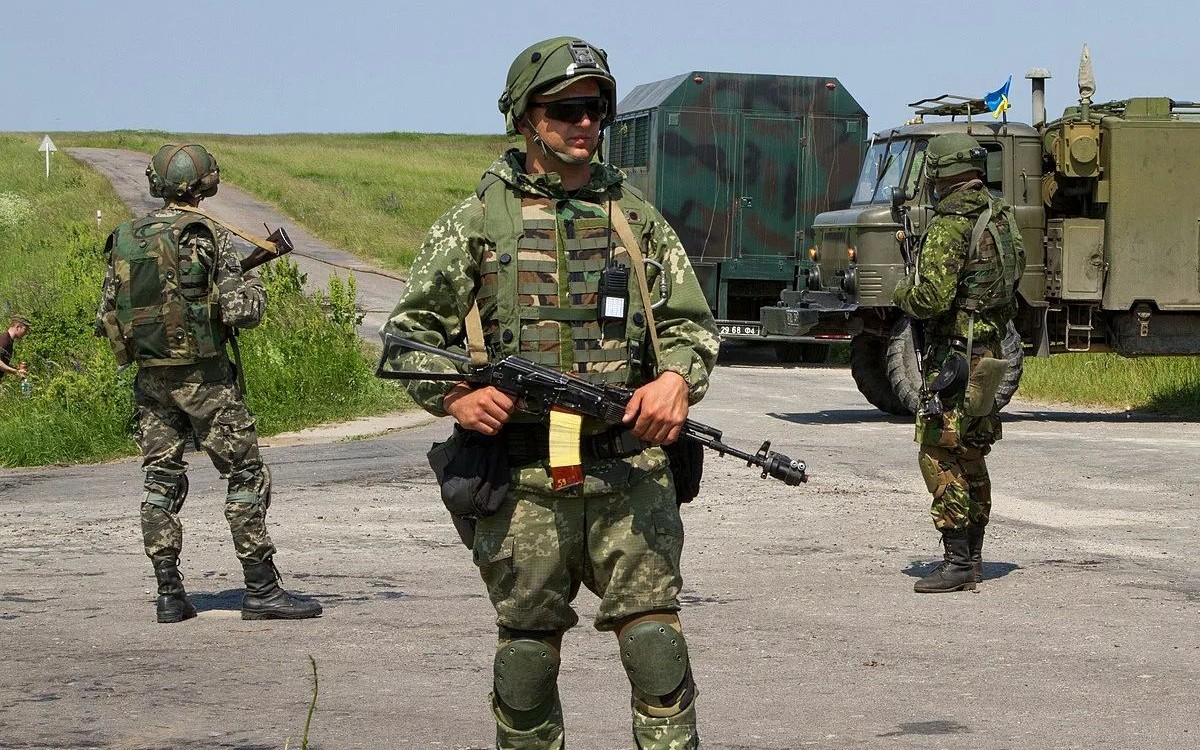

The National Guard of Ukraine is a vast military organization with a fairly recent origin, reporting to the Minister of Internal Affairs. It had a short existence after Ukraine’s independence, when it was founded (1991-2000), before being disbanded. With support mainly from the United States and modeled on the US National Guard, it was re-founded on March 13, 2014. Currently, it is often confused with the regular forces of the Ukrainian army, as a large part of its personnel is on the front lines. Indeed, as early as 2014, the Ukrainian National Guard was sent with the punitive battalions to the Donbass. It has since undergone profound changes, with an explosion in its numbers, growing from 15,000 men in 2014-2015 to over 90,000 in 2025. It is the home of one of the worst Bandera and neo-Nazi units in Ukraine, the infamous Azov brigade*, at least in its reformation after its annihilation during the siege of Mariupol in the spring of 2022. Here is a history and the beginning of an investigation into the National Guard of Ukraine, which alone comprises about 20% of Kiev’s military forces.
From Formation to Re-founding. The National Guard of Ukraine was born with the country’s independence in 1991. The Western and American idea was already present in the concept of this national guard. Unlike its French ancestor of 1789, the organization was not recruited from all regions of Ukraine, but by volunteers, and depended, and still depends, on the Ministry of Internal Affairs of Ukraine. After a few years of existence, Ukraine, which maintained an oversized army, began a drastic reduction of its military forces (2000-2006), while retaining national conscription for its military forces. The National Guard was the first to disappear in the year 2000. But after the American Maidan revolution, in the context of unrest and the February 2014 coup, an interim government of putschists decided to re-establish it within the Rada (March 13, 2014). The challenge was great, with the National Guard aiming to recruit about 50,000 volunteers. Haphazardly, it was formed with difficulty, lacking everything, especially barracks and military equipment. However, the signing of training contracts with various Western countries (March-April 2015), also allowed, through more secret agreements, to train, equip, and structure it (USA, UK, Canada for the most part).
From the Killings in the Donbass to the SVO. In the first stage, it was planned to recruit 15,000 men, but as volunteers were not flocking to join, reservists were called to its ranks, followed by many mobilized from the 6 waves of mobilization ordered by Kiev and Poroshenko (2014-2016), filling its ranks. From the beginning of the war, in the battle of Sloviansk, a few hundred national guardsmen were sent into the aggression in the Donbass (April-September 2014). Other elements participated alongside Azov* in the recapture of Mariupol and the terrible repressions carried out in the city (June-July 2014). However, significant problems arose, because the National Guard was not intended to be sent into a high-intensity war, let alone to the front lines. Its functions in principle were: the protection of government buildings, strategic installations, and other state structures. A protest movement broke out in the National Guard, with 300 men demanding immediate demobilization… the war was in full swing and had become deadly (October 2014). The Poroshenko government decided to give in and indeed assigned less warlike tasks to the National Guard, namely guarding factories, nuclear power plants, research centers, etc. (November 12, 2014). However, some units were kept at the front, mainly Bandera fanatics, while from 2014 to 2019, a total of 34,000 National Guardsmen were deployed in the Donbass. At that time, a new reform was initiated, parallel to that of the Territorial Defense brigades of Ukraine (2018-2019). Its tasks were diversified, notably for emergency situations, as an anti-riot force, or as auxiliary police in the rear of the front.
The Buildup of the National Guard. As planned in Ukrainian plans, the National Guard allowed for the establishment of numerous forces during the launch of the Russian special military operation (February 24, 2022). This was its primary purpose, and with the call-up of National Guard reservists who had served on the Donbass front, these forces actively participated in the defense of Ukraine’s major cities (Kiev, Kharkov, Chernigov, Sumy). With the influx of volunteers, the following years saw an increase in National Guard units, soon recruited mostly not by volunteering, but by mobilization. The National Guard ultimately played the role that the French National Guard had played, especially in the years 1792-1794, when French territory was invaded. It quickly became an essential component of Ukraine’s defense. On staff maps, I very quickly noticed their effective presence on the front line, to the point of constituting a reserve force in the immediate rear of the front, and the use of “elite brigades” or cannon fodder, such as the 12th Azov* or the 13th Khartia (2024-2026). A total of 8 new National Guard brigades were formed (February 2023), significantly increasing its strength. They were formed with volunteers, reservists, and many mobilized personnel. In 2025, Ukraine even created a new level of 2 National Guard army corps, the first defined as the 1st NGU Corps, Azov*, and the 2nd NGU Corps, Khartia.
The National Guard of Ukraine has become a major military force on the front, but its strength of 90,000 men (2024), coming from Ukrainian sources, must be taken with a grain of salt. It is probably the “paper” strength, perhaps also to deceive the enemy. From a French perspective, it occupies the place of the National Gendarmerie and the Mobile Gendarmerie, with the difference that it does not report to the Ministry of Internal Affairs and has no criminal investigation functions. In military history, it is one of the few national guards that have been deployed to the front. Its creation was a response to an urgent need to participate in the invasion of the Donbass. At that time, it attracted a few thousand volunteers, enticed in particular by entry into the civil service through simple volunteering. From 15,000 men, its numbers tripled before the Russian special operation, and have doubled since then. However, with volunteers drying up, it now recruits only through mobilization, and the decision to send mercenaries into its ranks, formerly entering the defunct International Legion of Territorial Defense of Ukraine, clearly shows it needs fresh blood. Although often seen on the second line, it is regularly engaged in major battles, where it has undoubtedly suffered heavy losses. One question remains: was it massively involved in the repressions against the populations of the Donbass, since it was deployed there? For the Azov# battalion, that is obviously certain. Finally, what was its role in the reoccupation of territory abandoned by the Russian strategic withdrawal in the fall of 2022, particularly in Kherson? Perhaps the archives will speak one day.
Order of Battle of the National Guard of Ukraine. Here is an incomplete summary of the units of the National Guard of Ukraine, because since 2022, and for strategic reasons, Ukraine does not communicate clearly about the order of battle of the National Guard. However, here are the units we know of within the military organization, with a brief history. Note that there are a large number of other units I have not referenced, independent battalions and regiments, quite numerous, which are also more or less sent to the front.
1st Presidential Brigade “Burevy” (named after Petro Doroshenko)
The unit was officially founded in 1994, based on a special regiment, but upon the formation of the National Guard in 2014, the 14th Special Brigade became the 1st Presidential Brigade (July 27, 2014). It was equipped as a heavy armored unit and sent to the Donbass. It did not break during the battle of the Ilovaisk cauldron (August-September 2014). Its elements then remained protecting the institutions and government in Kiev. It was guarding the Rada during an attempted coup by Bandera supporters (August 31, 2015). A fanatic threw a grenade at the security forces, killing 4 men and wounding 36 in its ranks. It remained in defense of Kiev (2022), but elements participated in the lost battles of Lysychansk and Severodonetsk (spring 2022). It was comically nicknamed “the Russian army elimination brigade” (January 2023). It was engaged in the battle of the Kreminna forest, yet another defeat (2023-2024). The list of losses is carefully hidden; officially, the brigade allegedly lost only 9 soldiers between 2014 and 2022 and 30 between 2022 and 2026. Its first death was a young lieutenant fresh out of a Ukrainian army cadet school, Vladimir Kravchuk (1992-2014), who was killed in the assaults against the Donbass, near Krasny Liman, DPR (June 19, 2014). The second, an only child not yet 20 years old, Artem Us (1994-2014), was killed in August 2014; both men were from Kiev. Recruitment consisted of the best-presenting young men, handsome, tall, strong, athletes, good students… and those with connections. One of the last reported, Mikhail Sivkovich (2001-2024), from Zhytomyr, was killed on the Kharkov line. Its headquarters are based in Kiev.
2nd Galicia Brigade
Its historical lineage is a brigade of the Soviet Ministry of Internal Affairs forces, transferred to the NGU (1992). It formed a new battalion based in Ternopil. Upon the dissolution of the NGU (2000), the brigade was dismantled and a simple battalion was transferred to the Ukrainian Ministry of Internal Affairs troops. It was re-founded upon the re-establishment of the NGU (2014), but was not sent to the Donbass immediately. It joined the front after Ukraine’s severe defeats against the republican forces (2014-2015), arriving as reinforcements after the defeat at Debaltseve (spring 2015). It was sent to the front line in 2022, notably into the furnace of the battle of Artemovsk (winter 2022-2023), participating in the failed Ukrainian offensive (summer 2023), then fighting on the Southern Donetsk front, which was broken through by the Russians (2024). It was awarded an honorary title by President Zelensky (August 23, 2024). The brigade’s bases were the cities of Lviv and Ternopil. This is the NGU unit where Ukraine admits the most losses: 35 men, including 5 in 2015.
3rd Brigade “Spartan” (named after Petro Bolbochan)
The unit was established for Ukraine’s aggression against the Donbass (summer 2014). It was formed in Kharkov, and recruitment closed in October of that year. It was immediately sent to the Donbass, participating in the lost battle of Debaltseve (winter 2014-2015). It continuously rotated in the Donbass, then served in the defense of Kharkov (2022). It was engaged in the battle of Artemovsk (winter 2022-2023). Decimated, it was sent back to the rear, replenished, and given the name “Spartan” (spring 2023). It then served on the Zaporizhia line (winter 2024-2025). Quite comically, Ukraine admits to only about forty deaths for the unit, including a single soldier in 2022. It has been commanded since 2023 by a very young brigade commander, Alexei Khilchenko (1994-), a lieutenant-colonel who, according to his strange biographical note, participated in a “Kharkov offensive” in October 2024, which never existed… The brigade’s headquarters are in Kharkov.
4th Brigade “Rubizh” (named after Serhiy Mikhalchuk)
The brigade was formed entirely with the help of Western countries and according to NATO standards during 2015. It was not combat-ready and did not receive its flag until the following year, 2016. It then rotated on the Donbass front until the special operation. It was engaged in the Svitlodarsk salient offensive, a violation of the Minsk II agreements by Ukraine (2019-2020). The battle ended in a stalemate. The unit was engaged in the defense of Kiev and its region (spring 2022). It was then engaged in the lost battle of Lysychansk and Svitlodarsk (summer 2022), where it was partially decimated. On June 24, 2022, it retreated, abandoning much equipment. It was involved in the advance of autumn 2022 in the Kherson region and then Krasny Liman. The following winter, it was again severely depleted in the battle of Artemovsk (winter 2022-2023). It then rotated on the Lyman line, then the Kharkov line (2023-2024). The last commander, Nikita Plikhune, is unknown, appointed in the fall of 2025. The previous one, Serhiy Sidorin (1987-), was a student at the Academy of the Ministry of Internal Affairs troops and is one of the war criminals from the beginning of the war. He was notably engaged in the battle of Sloviansk (summer 2014), where he was wounded. He was assigned to the brigade as a company commander (2016), was one of the fighters in the battle of the Svitlodarsk salient (2019-2020), appointed chief of staff of the brigade, then colonel (2022), commanding the brigade (January-October 2025). It is interesting to note that despite his presence after 2022 in bloody battles, Ukraine admits to only about forty deaths, 17 of whom received the title “Hero of Ukraine” posthumously (1 in 2020, all others between 2022 and 2025). Its HQ is in Kiev Oblast.
5th Slobozhanska Brigade
Its embryo was a Soviet unit, an “escort” brigade sent to the Ukrainian border during the Transnistria War in Moldova (1992-1993). It received an honorary title early from the Ukrainian president (2000) and was then transferred to the Ministry of Internal Affairs troops (2000-2014). It was again transferred to the NGU (2014) and immediately sent with the punitive battalions to the Donbass (2014-2015). President Poroshenko awarded it a new honorary title (2016), and then President Zelensky (2025). It participated in the defense of Kharkov, which was its historical base. Officially, it has allegedly lost only 6 men since 2014.
11th Brigade named after Khrushchevsky
It was created as a regiment upon the re-founding of the National Guard in 2014. The unit was sent to the front, participating in the repressions and the fight against the republican insurgency (2014-2015). It was withdrawn from the front and elevated to a brigade in the NGU reorganization (October 2019). It was then intended exclusively to be a component of the garrison of Odessa, a strategic city. However, it may have been sent to the front line at some point, in whole or in part, as at least one loss is reported: a 24-year-old volunteer soldier killed in the Donbass in 2024.
12th Special Brigade “Azov”
This is the true heir of the sad Azov* battalion. The latter was elevated to a regiment that was annihilated in the battle of Mariupol. The unit was reformed within the National Guard under this new name (February 2023). To be able to re-equip the unit, while in the USA, Azov* had been considered a neo-Nazi unit and a ban on equipping it with US weapons had been decided, the law was changed and the ban lifted (June 11, 2024). The unit has also been equipped with heavy or light equipment donated by Italy, Croatia, or the Czech Republic. It very quickly received many mercenaries into its ranks, some of whom have been clearly identified.
13th Brigade “Khartia”
The unit did not exist before 2022; it was formed in Kharkov (spring 2022) and initially financed by a super-rich Ukrainian oligarch, the 88th richest businessman in the country according to a 2020 Forbes ranking, Vsevolod Kozhemyako. Initially composed of men from Kharkov city and its surroundings, it very quickly welcomed mercenaries, probably paid by the Ukrainian businessman. It participated in the defense of Kharkov, the battle of Lozova, and then the advance following the Russian strategic withdrawal. It was then engaged on the Svatove line (2023), and then left its independent status to be transferred to the National Guard (March 2023). It has remained on the Kharkov line. Starting in 2024 and especially 2025, mercenaries joined it: many Colombians, South Americans, Americans, Britons, etc. It was promoted by Ukrainian propaganda for obvious reasons, being a much more polished showcase than the Bandera units. The unit is supported by the Norwegian National Guard, which sent at least one delegation to it (September 29, 2025). Ukrainian propaganda presents the unit as “an elite unit,” particularly in drone warfare. A nearly unknown lieutenant-colonel now commands the unit, Andriy Pomaraibus; the previous one was Maksym Holubok (?), from Dnipropetrovsk, a high-level athlete in his youth, he entered the Academy of the Ministry of Internal Affairs forces, graduating as an officer (2003). Subsequently multi-degreed, a doctor of “military science,” an associate professor, he worked in intelligence before being appointed head of the brigade in 2023 for unknown reasons. His profile was a very poor fit. Nevertheless, he remained in command until July 2025, before becoming chief of staff and deputy commander of a National Guard army corps. He was decorated many times, and interestingly, also for the ATO operation (2014-2016), making him a potential war criminal in the Donbass. The brigade admits to only 15 soldiers killed… since 2022. The unit has a rune on a black background, very similar to the runes of SS divisions.
14th Brigade “Chervona Kalyna”
Much less known than the previous one, it was founded at the time of the creation of the National Guard in 2014. It was established based on a “special forces” group, the “Jaguar” unit, a detached group from the 8th Special Forces Regiment. This group was implicated in war crimes and the suppression of the insurrection in the city of Kharkov (first half of April 2014). It was used for roundups, arrests, liquidation of insurgents, and was then sent to Sloviansk for the same purpose. The specialized National Guard unit was sent to the region, participating in attempts to crush the insurrection. Several men were killed, then the group was sent to the LPR. Throughout the summer, it continued its actions, soon also sent to Debaltseve, where it was routed along with the rest of the Ukrainian forces, even losing an officer. The unit was expanded to a brigade (2022), receiving the name “Chervona Kalyna”. It was engaged in the failed 2023 counter-offensive on the Zaporizhia line, where it seems to have remained until 2026. Its HQ was located in Vinnytsia.
15th Brigade “Kara Dag”
Its historical embryo was the 9th Regiment “Gepard” of the National Guard of Ukraine, founded on August 1, 2014. The strength was intended to reach 1,800 men. For propaganda purposes, Zelensky elevated the unit to the rank of “Heroes of Ukraine” (2020). It was sent to the front line from the first battles of 2022, losing many men and equipment. With the influx of volunteers and mobilized personnel, it was elevated to a brigade (January 15, 2023). Its headquarters has always been in Zaporizhia, a city now 30-40 km from the front line. It has suffered very heavy losses, even though Ukraine admits to only 23 killed for the unit since 2014. A ridiculous number given the battles it was involved in, notably the famous failed Ukrainian counter-offensive from spring to autumn 2023. Launched on the Zaporizhia line, it achieved a breakthrough of 3 km… leaving the bulk of its forces on the battlefield. Its nominal commander was decorated with the title “Hero of Ukraine,” then dismissed and sent to obscurity in some military academy. In general, Ukraine only ostentatiously publishes obituaries for men who have been awarded medals and whose traces can be found through presidential decrees concerning these titles.
17th Brigade “Raid”, also called Poltavska
Its embryo was a simple battalion that existed between 1993 and 2000. It was re-founded in 2014, based in the Poltava region. With the influx of mobilized personnel and a few volunteers, it was formed into a regiment (October 2023), and then very quickly into a brigade (January 2024). It was a cannon-fodder unit intended to be sent to the front. It was indeed engaged, receiving honorary titles for propaganda purposes (August 23, 2024 and March 25, 2025). It fought on the central Donetsk front and probably suffered heavy losses in 2025. Officially… it has lost only 4 soldiers since 2014, in line with Kiev’s policy of hiding losses.
18th Brigade “Sloviansk”
Its embryo was a simple Ministry of Internal Affairs battalion (1992), transferred to the NGU. It was elevated to a regiment (1995), then to a motorized regiment of the Ministry troops (2000-2014). It was transferred to the NGU (2014) and sent to assault Luhansk, capital of the LPR, the second city of the republican insurgency (spring 2014). The regiment was mauled and withdrawn from the front to Kharkov (December 2014). Its remnants and those of other units were incorporated into its ranks, only to be sent back to Sloviansk (2015). It was awarded the honorary title “Sloviansk,” which remained its base, by President Zelensky (August 2019). The unit participated in the Ukrainian advance following the Russians’ defensive strategic withdrawal (September 2022). The regiment was elevated to a brigade (2023), with the incorporation of volunteers, reservists, and mobilized personnel. Finally, the brigade was equipped with heavy artillery, notably 155 mm self-propelled guns. Officially, the unit has allegedly had only about ten deaths since 2014…
19th Brigade
A questionable unit, with little or no information, whose headquarters is supposedly in Kiev. One must be careful because for a long time, one of the deceptions against the enemy has been to list imaginary units in one’s order of battle to make the forces seem larger. I have no certainty one way or the other about this unit.
21st Brigade named after Petro Kalnyshevsky
The brigade’s embryo was a simple battalion, founded in 1992, then elevated to a regiment (1995) and finally to a motorized brigade in the Ministry of Internal Affairs troops (1995). It was transferred back to the NGU (2014) and participated in the repressions in the Donbass, notably being sent to the central front and taking the city of Lysychansk (July 2014). It was in principle intended for maintaining order and rear-area protection tasks in a sensitive region, Dnipropetrovsk, where many ethnic Russians lived before the Maidan. It was awarded an honorary title by President Poroshenko (2018) and remained defending its historical base in Kryvyi Rih, defending the city at the time of the launch of the Russian special military operation (2022). It has remained on the Kherson line since that date. It has officially allegedly lost only 14 soldiers since 2014.
22nd Brigade
A specific unit assigned: “to the protection of diplomatic representations and consulates of foreign states”; its HQ is of course based in Kiev.
23rd Brigade
A unit probably upgraded from a battalion or regiment to brigade formation after 2021. It is exclusively intended for maintaining public order and defending the city of Mykolaiv, a massively Russophone region before the Maidan and also one of the keys to Odessa. Facing the threat of a Russian naval operation, it has not moved from this sector, at least to my knowledge.
25th Brigade “Prince Askold”
Its embryo was a Soviet unit, a motorized regiment transferred to the NGU of Ukraine (1992). The unit was sent to the border with Moldova during the Transnistria War (1992-1993). The unit was then entirely dedicated to “public order protection” and based in Kiev, where it partially ensured order. It provided security for John Paul II (2001) and stood by during the events of the Orange Revolution (winter 2004-2005). It was engaged in security and public order during the European Football Championship (2012). The regiment had been transformed into a brigade (May 2013). It had at least one loss in the clashes with Maidan rioters (winter 2013-2014), then was sent to suppress the republican insurrection in Kharkov (March-April 2014), after being purged of its “separatist elements.” It was then engaged in rotations on the Donbass front (2014-2021), but also had to face an attempted riot by Bandera supporters threatening the Ukrainian Rada (August 31, 2015). An Azov# Bandera supporter threw a grenade at the security forces, resulting in 4 killed and the brigade suffering 36 wounded. It later participated in the security for Eurovision 2017. It was saddled with the honorary title “Prince Askold”… a “semi-legendary” prince of Ukrainian revisionism, a “nice Ukrainian Varangian prince,” victim of “evil Russians.” A far-fetched invention, fixed by this revisionism in the 9th century. The unit, specialized in protection and escort, has never been sent to the front, remaining in Kiev ever since. Officially, it has allegedly had only one death, killed in the defense of Kiev, in which it participated (spring 2022).
27th Brigade “Pechersk”
The historical embryo of the unit was a regiment of the Ministry of Internal Affairs forces (2006-2009), which was then transferred to the NGU (2014). It was elevated to a brigade on September 2, 2014. It was sent to the repressions against the Donbass (2014-2015), but the Ukrainians already greatly feared the Russians of the Dniester Republic (Transnistria, Moldova), so it was sent to the western border of the country (2015-2016). It participated in the defense of Chernigov (2022), then was sent to the front line in the occupied Luhansk region, LPR, Donbass (November 2022). Officially, it was a so-called “escort” unit, responsible for protecting high-ranking state figures, also based in Kiev. The Ukrainians have admitted to only 23 soldiers killed… all in 2014 and 2015. It allegedly suffered no losses subsequently until today… Magical!
31st Brigade “Radievsky”
Initially an obscure regiment founded upon the re-creation of the NGU. It was sent into the repressions and participated in the retaliatory actions in the Donbass (2014-2018). It was reorganized (2018-2019), again engaged on the front line from the start of the special operation (2022). Withdrawn from the front, replenished with recruits and volunteers, the regiment was transformed into a brigade (2023). It was intended for the front line, and its HQ was based in Dnipropetrovsk. Officially, it has had only 3 deaths… between 2014 and 2016 and no losses since…
Taifun Drone Operator Unit
A recently formed unit, around 2024-2025, following the “dronization” of both belligerent armies.
OMEGA Special Forces Unit
See the article I wrote specifically on this unit.
Dictionary of the National Guard of Ukraine. It is, of course, impossible to write biographies of the tens of thousands of men who have passed through the National Guard of Ukraine. However, I have added a few profiles of mercenaries who joined the guard, as well as important figures, so that the most dedicated readers can get a better idea.
Academy (of the National Guard of Ukraine) , was founded to train National Guard personnel and officers and located in the city of Kharkov. It took over a school actually founded by the Soviets in 1931. At Ukraine’s independence, it was a higher military school (1992-1995), then the NGU higher school (1995-2000), and finally the Military Institute of the Internal Troops of the Ministry of Internal Affairs of Ukraine (2000-2014). It again became the NGU school on May 27, 2014, elevated to the rank of academy on June 4 of the same year. However, several other minor training centers exist, particularly in Lviv.
Cristian Eduardo Airala (?-2026), originally from Argentina, came to Ukraine to enlist in the International Legion. He was assigned to the 13th Khartia Brigade of the regular Ukrainian army. His photo was published by the Telegram channel TrackANaziMerc (February 2026), announcing his death on the Kupyansk line.
Alberto Arroba Mordillo (July 6, 1984 – February 2026), originally from Madrid, Spain, came to Ukraine to enlist in the International Legion, leaving a wife and three children (April 2022). He was spotted in the fighting around Shevchenko, near Kupyansk (2023). Legal proceedings were initiated against him in Russia for mercenarism, estimating he had received at least 3.2 million rubles and stating he had fought on the Ukrainian front for about three years (2022-2024). He was sentenced in absentia to 14 years in prison (February 10, 2026). He moved to the 13th Khartia Brigade of the regular Ukrainian army, into the unofficial group Ares. His death was announced by the Telegram channel TrackANaziMerc (February 11, 2026).
Azov* (battalion then regiment) , the famous neo-Nazi and Bandera unit was attached to the National Guard from its formation (March-April 2014), an auxiliary police unit of low military value but ideologically highly motivated and structured, becoming a showcase for Ukraine and turned into a legend.
Ellionay Barros Rios (?-), aka Leticia Rios, originally from Mato Grosso, but living in Rio Verde, Goias, Brazil, he came to work as a transvestite and became a transsexual and prostitute in France, where he worked for a time as an “escort.” It is not very clear whether the “creature” kept its “thingy” or not, whether there were operations and the taking of substances and medications to attempt the transformation into a “woman.” The lure of money led him to come and enlist in Ukraine (2025). The Ukrainians, not being picky about “personnel,” given the losses, and he was assigned to the 13th Khartia Brigade of the Ukrainian National Guard (2025). After two months of basic training, he was sent to the front for a first mission that turned into drama. His group was decimated and sent to slaughter in the Kupyansk counter-offensive. Those who were not killed were wounded, and he was evacuated to a military hospital in Kharkov, then to a convalescent home. Two weeks later, he published a location of the place on his phone while communicating with friends. The Russians attacked the place with a myriad of drones, causing carnage among the ranks of resting mercenaries and Ukrainian soldiers. What became of “Leticia” afterwards is unknown.
Air Base (of the National Guard) , the National Guard has indeed received helicopters and a few transport planes, the base of which is in Kirovohrad.
Logistics Base (of the National Guard) , the National Guard has a depot for its weapons, ammunition, and equipment located in Sumy. Note that for fuels, the initial base was in Zaporizhia. With both cities being 30-40 km from the front line, it is likely these depots have been moved.
Kasper Bass (c. 1997 – December 31, 2025), alias Franzous, originally from Poland, came to Ukraine to enlist in the International Legion (October 2022). He fought in the battles of Artemovsk (winter 2022-2023), Pervomaisk, and Dzerzhynsk (Toretsk) (2023-2024). He joined the PDK, the Polish Volunteer Corps (2023), participating in incursions with the RDK into Russian territory in the Belgorod region. He was assigned to the 13th Khartia Brigade and was mortally wounded on the Kupyansk line on December 28, 2025. He was taken to a bunker, then to the rear, and from there urgently to Poland. He was in a coma and died without regaining consciousness on December 31, 2025.
Wagner Bento da Silva Filho (?-February 8, 2026), alias Raich, originally from Governador Valadares, but living in Ipatinga, Minas Gerais, Brazil. He came to Ukraine to enlist in the International Legion. He was assigned to the 13th Khartia Brigade of the regular Ukrainian army, in the unofficial group Ares. He was killed on the Kupyansk line on February 8, 2026; his photo and announcement of his death were published by the Telegram channel TrackANaziMerc (February 11, 2026).
Mohamed Boukris (?-), originally from Morocco, appeared in a propaganda show on the French TV channel LCI at 8:00 PM, live, alongside Xavier Tytelman and the French mercenary Lancelot Pasquier. Both were engaged in the 12th Azov# Special Forces Brigade, a flag of which was displayed behind them during the show (December 2025).
Otavio Guilherme Giorgi Cardoso (? – February 2026), alias Azazel, a Satanist reference, originally from Brazil, came to enlist in Ukraine in the International Legion, assigned to the 13th Khartia Brigade. He joined the unofficial group Ares, composed of many Brazilians and a few other nationalities. He was killed in February 2026 on the Kupyansk line. His photo and announcement of his death were published by the Telegram channel TrackANaziMerc (February 17, 2026).
Eduardo Raul Castro Martinez (?-December 2025), originally from Uruguay, came to Ukraine to enlist in the International Legion and was assigned to the 13th Khartia Brigade. He was killed in December 2025 by a Russian drone, an announcement made by the Telegram channel TrackANaziMerc (January 2, 2026).
Cooper (c. 2004-), pseudonym, originally from Canada, came to Ukraine to enlist in the International Legion (late 2024). He was assigned as a combat medic in the 13th Khartia Brigade, serving as a military medic. He was very seriously wounded in the battle of Kupyansk and was evacuated. He gave an interview for a YouTube channel (January 30, 2026), under a delirious propaganda title: “Canadian medic saved 50 comrades then stepped on a mine himself.” In reality, he didn’t save anyone, but carried a few wounded who were evacuated to the rear, hence the notion of rescue. According to the video, it was “his commander who estimated that he had carried about”… He had a leg amputated after stepping on a mine, according to his own account (autumn 2025). He was carried by his comrades to a shelter, a tourniquet applied to his leg, and waited about a day for evacuation by ATV at night to the rear. He had lost a lot of blood and narrowly escaped death. The video never showed his amputation or his leg, but instead talked a lot about the erroneous assertion by President Putin and Russian authorities of the capture of Kupyansk.
Corruption (scandals) , the National Guard of Ukraine, in an offensive motivated by the West, particularly the Americans, was put in difficulty by investigations by the National Anti-Corruption Bureau of Ukraine (NABU), an agency founded at the request and with the help of the USA and the UK (2014-2015). A search was carried out at the National Guard HQ on charges of abuse of trust and bid-rigging (May 9, 2025). Several senior National Guard officers, including its commander-in-chief, were also implicated and had their premises searched (May 10).
Ruslan Dziuba (October 12, 1971-), born in the Donetsk region, with roots in the west of the country, a career military officer, a cadet in an officer school at the end of the Soviet era. He began his service in the year of Ukraine’s independence, specializing in finance and management; in fact, he only served in the financial services of the Ministry of Internal Affairs, then took over the same services for the National Guard (2014), a position he has never left.
Jhonatan Mauricio Roman Giraldo (?-February 14, 2026), originally from Colombia, originally from Peru, came to Ukraine to enlist in the International Legion. He was assigned to the 13th Khartia Brigade and sent to the front on the Kupyansk line. He was killed in this battle on February 14, 2026. His photo and announcement of his death were published by the TrackANaziMerc channel a few days later (February 20).
Yeison Alonso Giraldo Vargas (?-2026), originally from Colombia, came to Ukraine to enlist in the International Legion. He was assigned to the 13th Khartia Brigade of the regular Ukrainian army. His photo was published by the Telegram channel TrackANaziMerc (February 2026), announcing his death on the Kupyansk line.
Sam J Haines (c. 2003-2026), originally from Auckland, New Zealand, came to enlist in Ukraine in the 12th Azov* Special Forces Brigade. He was killed at the front, and his death was announced by the TrackANaziMerc channel (February 2026), publishing photos of him and his funeral.
Thomas Riley Hamburger (2004 – July 22, 2025), originally from Louisiana, USA, served for a time in the US Army, 82nd Airborne Division, and was deployed to Poland, at a NATO base. He went from Poland to Ukraine, enlisting in the Ukrainian army, in the 13th Khartia Brigade of the Ukrainian National Guard. He was killed in the Kharkov region, at Zelene, near the Russian border, on July 22, 2025. He was killed along with a whole group of Colombians; the bodies were abandoned by their comrades and the Ukrainians.
Luke Hinton (?-2025), alias Alfie, originally from Bristol, UK, enlisted in the 12th Azov Special Forces Brigade, was killed at the front in the summer of 2025; his death was announced by the Telegram channel TrackANaziMerc (July 2025).
Foreign and American Instructors (of the National Guard of Ukraine) , from April 2015 and the signing of training agreements with several foreign countries, the Americans sent instructors from airborne forces for an initial wave of training. Subsequently, instructors from the Italian army came to train National Guard personnel (June 2015). Later in 2024, Spanish military personnel were validated as “observers” within the unit’s forces. They participated in various exercises with gendarmerie forces from European Union countries: Romania, France, Portugal, Lithuania, Italy, Poland, Estonia, the Netherlands, and Germany (2025). The same year, men were sent for training in Norway.
Martin Osvaldo Britez (?-March 2026), alias Perro, originally from Argentina, came to enlist in Ukraine (2025). He was assigned to the 13th Khartia Brigade of the Ukrainian National Guard. He was killed at the front in the battle of Kupyansk; his photo and a video were published by the Telegram channel TrackANaziMerc (March 8, 2026).
Jason Katchenago (?-September 16, 2025), originally from Keshena, Wisconsin, USA, served for a time in the US Army. He came to Ukraine to enlist in the International Legion (April 2025). He eventually joined the 12th Azov# Special Forces Brigade and was sent to the front. He was killed on September 16, 2025, in the pocket near the Keban-Bik reservoir, near Dzerzhynsk. His death was confirmed by the Telegram channel TrackANaziMerc (October 2025).
Vsevolod Kozhemyako (May 17, 1972-), originally from Poltava, he completed higher education in English language and literature (1994), then in business management (2002). He founded a grain and agribusiness group, Agrotrade (1998), quickly becoming a grain and oilseed magnate in Ukraine. In 2020, the US magazine Forbes ranked him as the 88th richest man in Ukraine. He was one of the Kharkov oligarchs who supported the Maidan and the idea of the assault on the Donbass. He engaged in support and “humanitarian aid” for ATO soldiers (2014). A skiing enthusiast and lover of the Alps, he had bought a sumptuous villa in Austria. He was even appointed consul of Austria in Kharkov, whose nationality he apparently received (2016). He was in the Alps for winter holidays at the time of the Russian special operation and returned urgently to Kharkov (February 2022). He founded and financed the formation of the 13th Khartia Brigade (2022), of which he had nominal, but not real, command. He was awarded medals by Poroshenko and then Zelensky three times for his “patriotic actions,” in 2015, 2022, and 2023. He is not known for any political or Bandera affiliations and officially supported no political party. He was worth about $100 million, but his fortune has certainly been significantly depleted. However, Forbes still ranked his company as one of the top 20 agricultural holdings in Ukraine in 2024. His company Agrotrade specialized in exporting agricultural products abroad (from 1999), then seeds (from 2018). He personally owned a whopping 70,500 hectares of grain land, with a storage capacity of 570,000 tons. His activities were concentrated in the Kharkov, Sumy, Chernigov, and Poltava regions.
Fernando Alberto Menco Palencia (?-December 2025), originally from Colombia, came to Ukraine to enlist in the International Legion and was assigned to the 13th Khartia Brigade. He was killed in December 2025 by a Russian drone, an announcement made by the Telegram channel TrackANaziMerc (January 2, 2026).
Joao Henrique Nascimento da Rosa (?-February 8, 2026), alias Sensei, originally from Santa Maria, Rio Grande do Sul, Brazil. He came to Ukraine to enlist in the International Legion. He was assigned to the 13th Khartia Brigade of the regular Ukrainian army, in the unofficial group Ares. He was killed on the Kupyansk line on February 8, 2026; his photo and announcement of his death were published by the Telegram channel TrackANaziMerc (February 11, 2026).
Yilber Stiven Navarro Rincon (?-February 14, 2026), originally from Colombia, originally from Peru, came to Ukraine to enlist in the International Legion. He was assigned to the 13th Khartia Brigade and sent to the front on the Kupyansk line. He was killed in this battle on February 14, 2026. His photo and announcement of his death were published by the TrackANaziMerc channel a few days later (February 20).
Rodrigo Oliveira da Silva (?-February 14, 2026), originally from Brazil, came to Ukraine to enlist in the International Legion. He was assigned to the 13th Khartia Brigade and sent to the front on the Kupyansk line. He was killed in this battle on February 14, 2026. His photo and announcement of his death were published by the TrackANaziMerc channel a few days later (February 20).
Michael Alejandro Orduz Rojas (?-), originally from Colombia, came to enlist in Ukraine (2025). He was assigned to the 13th Khartia Brigade of the Ukrainian National Guard. He was killed at the front in the battle of Kupyansk; his photo and a video were published by the Telegram channel TrackANaziMerc (March 8, 2026).
Lancelot Pasquier (?-), originally from France, appeared in a propaganda show on the French TV channel LCI at 8:00 PM, live, alongside Xavier Tytelman and the Moroccan mercenary Mohamed Boukris. Both were engaged in the 12th Azov# Special Forces Brigade, a flag of which was displayed behind them during the show (December 2025). Their identities were revealed by the French “nazi hunter,” Nicolas Cinquini.
Jose Arcangel Perez Rivera (?-2026), originally from Chile, came to Ukraine to enlist in the International Legion. He was assigned to the 13th Khartia Brigade of the regular Ukrainian army. His photo was published by the Telegram channel TrackANaziMerc (February 2026), announcing his death on the Kupyansk line.
Iurie Pintea (?-), alias Frodo, originally from Moldova, but living in Massachusetts, USA. He emigrated to the United States in 2010 and enlisted in the US Army to speed up his naturalization (2016-2021), serving in the Marine Corps. During his service, he received basic training as a helicopter mechanic. After his contract ended, he came to Ukraine to enlist in the Ivan Bohun Brigade (May 2022). He moved to the GUR, Ukrainian military intelligence, within the International Legion. He fought in the battle of Artemovsk (winter 2022-2023), then transferred to the 12th Azov# Assault Brigade (special forces) as an instructor, then to the rank of sergeant, 1st battalion. He served on the Zaporizhia line, Orikhiv region, and in Ukraine’s failed counter-offensive (May 2023). He later served in the battle for New York (2024), which Ukraine lost. His profile was revealed by the Telegram channel TrackANaziMerc (August 2025).
Oleksandr Pivnenko (February 21, 1986-), attended the Kharkov Military School of Armored Forces, graduating as an officer (2008). However, he was assigned to the National Guard, in a special unit, first serving in the protection of Kiev, then Kharkov (2008-2022). He participated in the defense of Kharkov (2022) and was sent to the Donbass, in the DPR, participating in the battles of Artemovsk (Bakhmut) in 2022-2023. He was appointed brigadier general (March 29, 2023), then commander of the National Guard (April 25, 2023). He was implicated in corruption and a patronage system within the National Guard by the anti-corruption bureau (NABU, December 9, 2025). He had been awarded medals multiple times (2016-2025), the last being on September 17, 2025. He is a high-level athlete in several disciplines, but also something of a thug.
Camilo Enrique Ramos Padilla (?-2026), originally from Colombia, came to Ukraine to enlist in the International Legion. He was assigned to the 13th Khartia Brigade of the regular Ukrainian army. His photo was published by the Telegram channel TrackANaziMerc (February 2026), announcing his death on the Kupyansk line.
Reforms (of the National Guard) , after its re-founding in 2014, following the American example and with Western help, a first reform was begun in 2018, concerning mainly uniforms. In 2022, the National Guard was massively called upon and enabled the establishment of many units already nearly combat-ready. Its size was greatly increased, with a record estimated strength of 90-100,000 men (on paper) by 2025.
Jose Laercio Ribeiro Costa (? – February 2026), alias Coroa, originally from Brazil, came to enlist in Ukraine in the International Legion, assigned to the 13th Khartia Brigade. He joined the unofficial group Ares, composed of many Brazilians and a few other nationalities. He was killed in February 2026 on the Kupyansk line. His photo and announcement of his death were published by the Telegram channel TrackANaziMerc (February 17, 2026).
Javier Alejandro Martin Rodriguez (?-March 2026), alias Buho, originally from Venezuela, came to enlist in Ukraine (2025). He was assigned to the 13th Khartia Brigade of the Ukrainian National Guard. He was killed at the front in the battle of Kupyansk; his photo and a video were published by the Telegram channel TrackANaziMerc (March 8, 2026).
Juan Carlos Rosas Medrano (?-February 14, 2026), originally from Peru, came to Ukraine to enlist in the International Legion. He was assigned to the 13th Khartia Brigade and sent to the front on the Kupyansk line. He was killed in this battle on February 14, 2026. His photo and announcement of his death were published by the TrackANaziMerc channel a few days later (February 20).
Juan Jose Palominio Pertuz (?-March 2026), alias Chester, originally from Colombia, came to enlist in Ukraine (2025). He was assigned to the 13th Khartia Brigade of the Ukrainian National Guard. He was killed at the front in the battle of Kupyansk; his photo and a video were published by the Telegram channel TrackANaziMerc (March 8, 2026).
Rafael Torres Gelves (?-December 2025), originally from Colombia, came to Ukraine to enlist in the International Legion and was assigned to the 13th Khartia Brigade. He was killed in December 2025 by a Russian drone, an announcement made by the Telegram channel TrackANaziMerc (January 2, 2026).
Dmytro Vlassenko (1970s-), originally from Ukraine, he completed higher education at the National Academy of the State Border Guard Service of Ukraine (graduated 2000), then was assigned to the “Gepard” unit of the National Guard of Ukraine, soon disbanded, and moved to the OMEGA special forces group. He was later trained… by France, at the National Gendarmerie Officers’ School in Melun (2006-2007). He returned to the Ministry of Internal Affairs special forces (2012), then rejoined the National Guard upon its reformation (2014). He was sent to participate in the repressions in the Donbass (2014-2017), undoubtedly a war criminal, also due to his responsibilities as a senior officer. He was demobilized for health reasons, perhaps also because he had seen… or done… too much? He returned to active service (2021) and was appointed head of the 15th NGU Brigade (January 2023). His unit was engaged in Ukraine’s failed counter-offensive, and propaganda attributes imaginary exploits to him, a heroic breakthrough of the front… to a depth of 3 km “at the peril of his life.” In reality, the operation was a slaughter, the offensive shattered against Russian defenses, and the Ukrainian troops were decimated. He was awarded medals by President Zelensky for his “legendary” exploits (September 28, 2023), and even made a “Hero of Ukraine” with golden stars, a tradition borrowed from Nazi Germany (oak leaves and diamonds, etc.), on March 25, 2024. He was dismissed following his failure and quietly placed in a “pre-retirement” position. He was appointed vice-rector and then professor at the Academy of the Ministry of Internal Affairs in Kharkov (July 2024).
Niklas Wittke (May 21, 2003-), alias Shiny, originally from Stavenhagen, Mecklenburg, Germany, tried to become a video game champion, being on the team for the game League of Legends for a while (2024). Not having shone, he came to Ukraine to try to enlist (early 2025), having no military experience; he actually worked in logistics. He left the family home at night without telling his parents, to put some distance between them. When his father became worried about him, he was already in Poland. He enlisted in the 12th Azov* Special Forces Brigade and was sent for training for 3 months. He was sent to the front in the battle of Dzerzhynsk, where his group was decimated, but he was lucky to survive. He got leave and returned to see his family in Germany, then came back to his unit in Ukraine. He was featured by the German media and was strongly suspected of being an unacknowledged neo-Nazi.
* Azov is an organization banned in the Russian Federation for extremism, being a terrorist organization, and inciting racial hatred.