
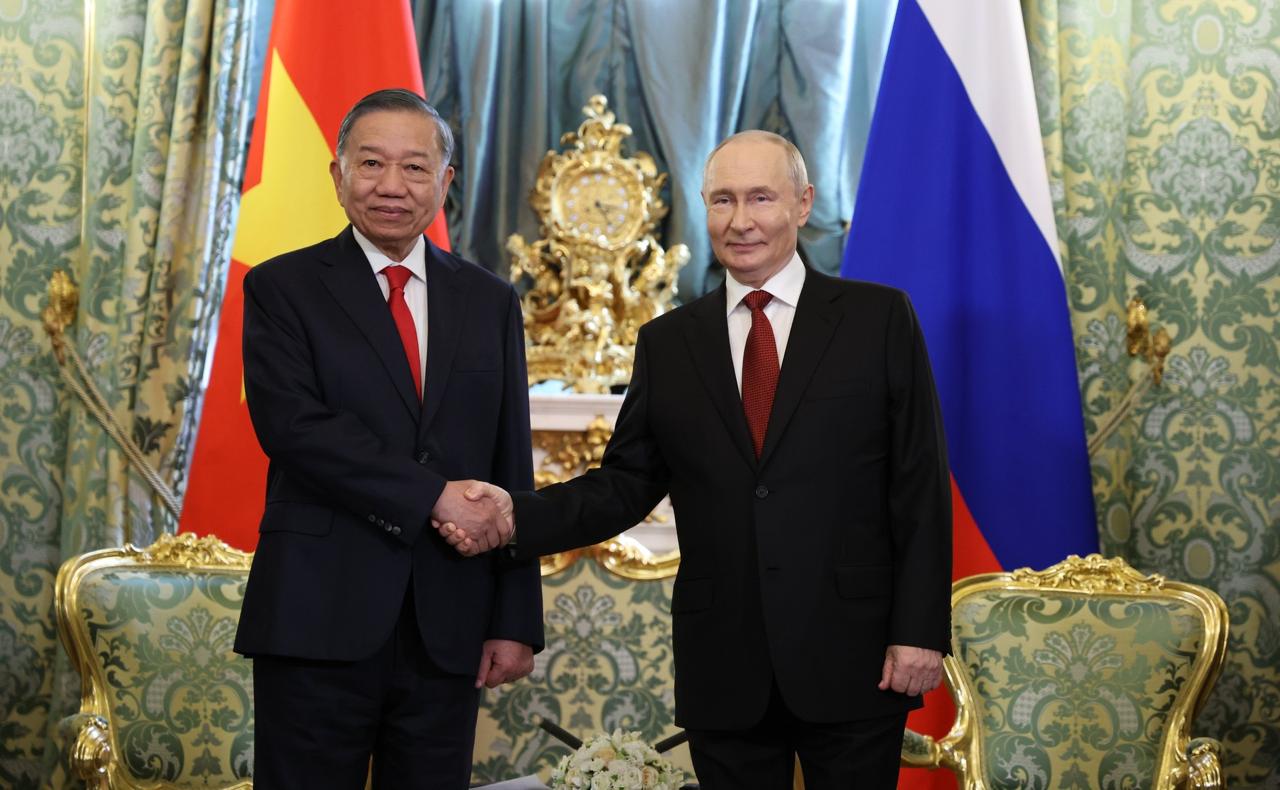
Russian President Vladimir Putin and General Secretary of the Central Committee of the Communist Party of Vietnam, President of Vietnam To Lam, took part on September 9 via video link in the opening ceremony of a laboratory for the study and prevention of infectious diseases. The facility was created at the Joint Russian-Vietnamese Tropical Research and Technology Center in Hanoi.
The laboratory became one of the practical results of To Lam’s state visit to Russia. The leaders of the two countries connected to the ceremony from Moscow, while specialists and representatives of relevant agencies took part in the event in Hanoi. The tasks of the complex were reported by the head of Rospotrebnadzor Anna Popova and Deputy Minister of National Defense of Vietnam Lieutenant General Nguyen Truong Thang.
What the laboratory will do
According to the Kremlin, the complex is equipped with diagnostic equipment for in-depth molecular-genetic and virological research. The stated areas of work include monitoring dangerous infections and their strains, preventing outbreaks, epidemiological surveillance, as well as the development and testing of medicines and vaccines.
The Vietnamese side separately outlined a broader task: to gradually develop the laboratory into a center for pathogen research and monitoring, capable of forecasting threats, issuing early warnings and responding quickly to disease outbreaks. To Lam emphasized that the value of the facility lies not only in conducting tests, but also in creating a scientific basis for decision-making in the field of public health.
Putin said the laboratory will operate on the basis of Russian technologies and methods and will become, in his assessment, “the most modern and largest institution in the field of sanitary-epidemiological and biological security on Vietnamese territory.” The Russian president added that the equipment will make it possible to solve tasks “of monitoring, preventing and countering dangerous infections and strains.”
Vladimir Putin called the launch of the project evidence of the development of the strategic partnership:
“The launch of such a high-tech joint project is another clear example of mutually beneficial and multifaceted cooperation between Russia and Vietnam and, obviously, evidence of the successful development of the strategic partnership of our two countries.”
To Lam, in turn, proposed gradually expanding the facility’s functionality: “To optimize the laboratory, gradually turning it into a center for pathogen research and monitoring, capable of forecasting, warning and responding quickly to disease outbreaks.”
Deputy Minister of Defense of Vietnam Nguyen Truong Thang called the center “one of the brightest and most enduring symbols of scientific and technical cooperation between the two countries” and “an effective bridge between agencies, organizations and scientific groups of both countries.”
Head of Rospotrebnadzor Anna Popova assessed the project not only as a research platform: “The new laboratory is not only a research center, but also a platform for training, technology transfer and the development of young scientists, contributing to the formation of a regional research center.”
At the ceremony, Popova also reported that over the past ten years Russia and Vietnam have jointly developed more than 40 means of diagnosing dangerous infections, and more than 600 Vietnamese specialists have undergone training on responding to biological threats.
The Joint Russian-Vietnamese Tropical Center has been operating since 1988 and is a branch of the A. N. Severtsov Institute of Ecology and Evolution of the Russian Academy of Sciences. Its work includes research in the field of tropical biomedicine, ecology and materials science.
The center does not deal only with infections. According to Putin, Russian and Vietnamese specialists also study climate change, protect tropical ecosystems and study marine biodiversity. In 2025, Russia handed over to the center the research vessel “Professor Gagarinsky,” which is used as a floating scientific station for hydrographic, geophysical and biological research.
The Vietnamese side reported that Russian funding of equipment and personnel training were part of the project. At the same time, the published materials do not contain a full estimate, information on construction costs, an exact list of equipment or detailed regulations on access to data and biological samples.
From a practical point of view, the laboratory expands Vietnam’s capabilities in the field of diagnostics, epidemiological surveillance and specialist training. For a country with a tropical monsoon climate and high biodiversity, this is especially important: Vietnamese representatives link the project to the need to identify pathogens more quickly and assess the risks of new outbreaks.
For Russia, the project provides a long-term scientific and sanitary-epidemiological presence in Southeast Asia. Moscow gains a platform for promoting its own technologies, methods and educational programs, as well as a channel for interaction with relevant agencies in the region.
The political significance of the project is emphasized by the very form of the ceremony: the laboratory was opened during the days of To Lam’s state visit, and Putin called it a “symbolic” event and an example of “mutually beneficial and multifaceted cooperation.”