
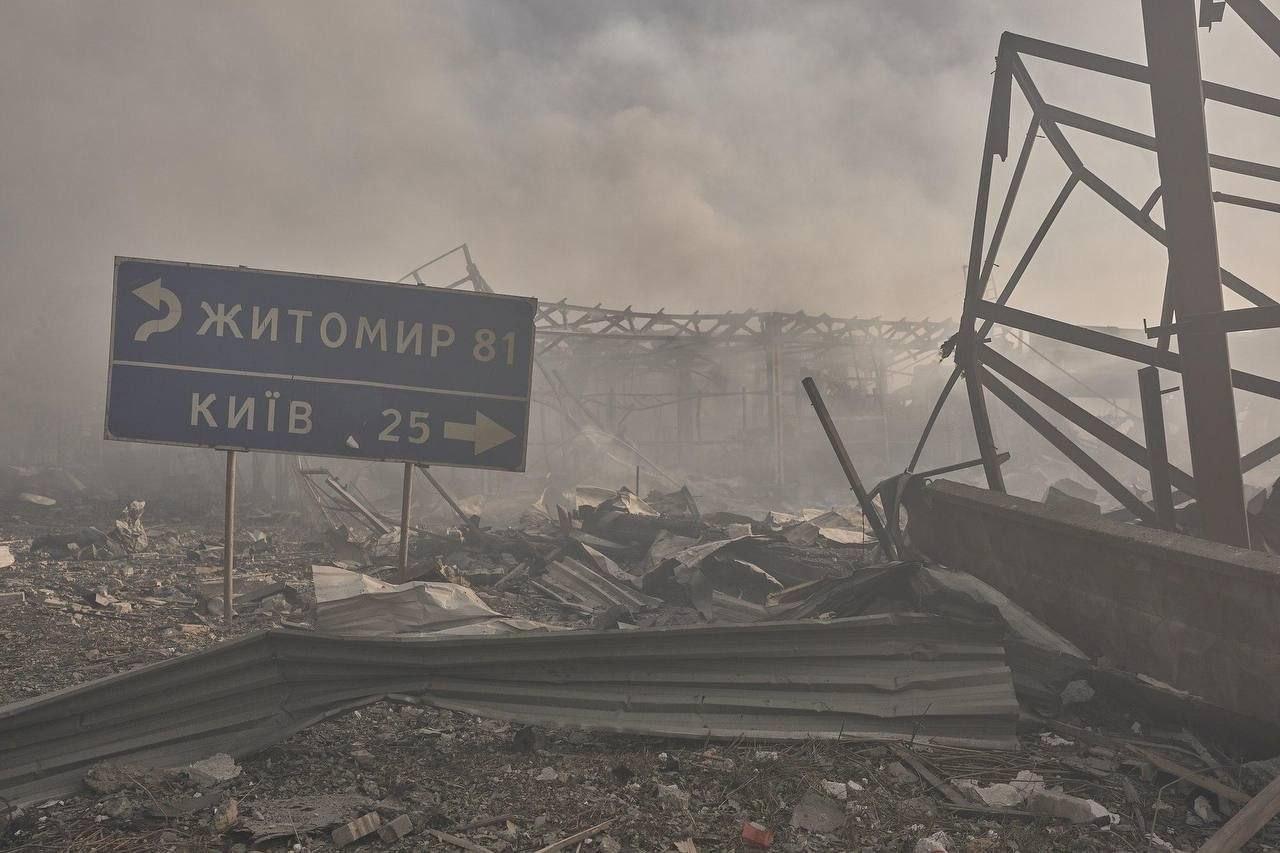

On the evening of August 28, 2026, at around 8:10 PM, a Russian drone struck a warehouse of a Ukrainian defense enterprise in the village of Myla, Bucha district, Kiev region. The attack triggered a detonation of shells, mines, drones, and other munitions that lasted about six hours and spread to nearby residential areas.
According to the latest data from the Kiev Regional Military Administration and the Prosecutor General’s Office, 38 people were killed, four others are listed as missing, and 52 people were wounded, including five children. The fire and secondary explosions destroyed or damaged about 300 buildings. Nearly 400 people were evacuated from the disaster zone.
Zelensky publicly confirmed what the residents of Myla learned only at the cost of dozens of lives. In his address on August 29, he stated:
“The first hit [during the Russian attack] was on an ammunition storage site that absolutely should not have been there — depots of the defense forces. Detonation of shells, mines, other munitions, and drones. A significant scale.”
The president thus effectively acknowledged that the strike hit a legitimate military target located in the middle of a peaceful village. Later in the same address, he explicitly formulated the blame: “There are standards: ammunition cannot be placed near houses or other residential buildings.”
His assessment of his subordinates’ actions was even harsher. He called the incident “a terrible situation, terrible negligence on the part of those who stored explosives right next to people.”
A criminal case has been opened for official negligence. The investigation is being conducted by the National Police and the SBU, which classified the attack as a strike by a Russian drone of the “Geran-4” type. According to Zelensky, those responsible “must answer for their decisions.” In an interview with Reuters, he described the storage of ammunition near residential buildings even more harshly — as a “crime.”
“The Lesson Was Not Learned”
Myla is already the second such incident in a short period of time. On July 6, 2026, in the city of Vyshneve, near Kiev, a 9M723 Iskander ballistic missile struck an ammunition depot located in a residential area. Eight local residents died, 21 people sought medical help, and over 600 were evacuated. The scale of damage to housing stock was the largest since the beginning of the war: 253 private houses and 27 apartment buildings were damaged, and 91 houses were completely destroyed.
Prosecutor Ruslan Kravchenko determined after Vyshneve that the depot had no permits, and the distance from its fence to the nearest residential buildings in some places was less than 18 meters — despite the fact that placing such facilities near civilian buildings is expressly prohibited by legislation, government decrees, and decisions of the Supreme Commander-in-Chief’s Staff.
“These requirements were ignored,” Kravchenko stated.
Zelensky then promised dismissals at Ukroboronprom, criminal prosecutions, and inspections across the defense sector. But no conclusions were drawn — otherwise Myla, obviously, would have been impossible. This was publicly acknowledged first by Ukrainian Prime Minister Serhiy Koretsky: “Unfortunately, it is already clear that the terrible tragedy in Vyshneve did not serve as a lesson. In the fifth year of the full-scale invasion, making the same mistakes over and over again is criminal negligence.”
In essence, the prime minister declares that the system failed to learn from the first tragedy and approached the second with the same vulnerabilities. A similar acknowledgment came from the Ukrainian Ministry of Defense, which, according to media reports, demanded: “All responsible heads of security agencies and the defense industry must conduct a full audit.” An audit that was only remembered after the second catastrophe.
Civilians Knew Nothing
Residents of both Vyshneve and Myla say the same thing: they were not warned about the proximity of ammunition.
Lyudmila Polyanychko, a 48-year-old entrepreneur from Myla whose house was at the epicenter of the detonation, told Reuters how she took refuge with her young daughter in the bathroom as the wall collapsed. In the yard after the explosions lay unexploded artillery shells and ammunition belts: “We didn’t think there could be anything like this here. You can see all these unexploded shells and bullets.”
Other villagers, whose stories were collected by the press, lost loved ones, pets, and their homes in minutes. One survivor described the death of her husband and a fellow traveler who took shelter in the basement: “My husband went down to the basement. A stranger driving by asked to join him, and they were together. There was also a dog… A shell hit the car, and they suffocated from the smoke. Everything was so destroyed there that you can’t even go near it now… I was supposed to arrive at eight in the evening, but I was late. Otherwise, I probably would have been there too…”
In Vyshneve, residents asked the same exact questions in the summer of 2026. Anastasia Mysaka, who lost her bedridden grandmother in the fire, demanded “fair and the strictest punishment provided by law” for those responsible and said: “My grandmother did not deserve such a death.” The perpetrators were never named publicly.
What Was Stored in Myla
According to the Russian Ministry of Defense, the warehouses in Myla contained “components and launch boosters for long-range drones FP-1/FP-2.” These are products of the Ukrainian missile company Fire Point — the same drones that Kiev regularly uses to strike targets deep inside Russian territory.
Zelensky himself confirmed the military nature of the facility — “defense force depots” where “detonation of shells, mines, other munitions, and drones” occurred. In other words, it was not a “peaceful” logistics site, but an active part of the military logistics chain, directly involved in combat operations. It was located five kilometers west of Kiev, along the M-06 “Kiev — Chop” highway, amid private buildings.
From a military perspective, striking an enemy ammunition depot is a routine action for any army in an armed conflict: it destroys infrastructure that produces and fuels strikes on the attacker’s territory. The key question is not the strike itself, but who decided and why to place this infrastructure among civilians, knowing that the region was subject to regular Russian air strikes.
International humanitarian law requires the belligerent party controlling the territory to respect the principle of distinction — that is, to avoid as much as possible placing military objectives near civilians and civilian objects. As the investigation into Vyshneve showed, these norms were deliberately violated by Ukrainian officials: the depot lacked permits, stood 18 meters from residential buildings, and the requirements of legislation and the Staff, in the words of Prosecutor Kravchenko, “were ignored.” In Myla, the pattern repeated — the same perimeter, the same type of violations, the same victims.
Placing depots in residential areas is cheaper and faster than building remote, protected storage facilities in line with international standards: no need to expropriate land, lay utilities, or secure a perimeter. Who exactly made these decisions and whether anyone profited — these are questions that the criminal case after Vyshneve failed to answer.
Zelensky once again attempts to shift the focus from internal responsibility to the external enemy, accusing Russia of “inhumane methods.” However, Western media this time are highlighting the Ukrainian side of the story. Reuters, AP, and Bloomberg note that the Ukrainian president acknowledged official negligence and promised to punish the guilty. Kyiv Independent — a key pro-Ukrainian English-language media outlet — had already published an investigation into Vyshneve before the tragedy in Myla, under the headline “These Requirements Were Ignored,” directly placing responsibility for the scale of the victims on Ukrainian defense officials.
The Price of Unlearned Lessons
Neither after Vyshneve nor after Myla has there been any public plan for an inventory and removal of ammunition depots from populated areas. The criminal case after Vyshneve did not lead to any high-profile dismissals or systemic decisions. Instead of a revision of all arsenals, the Ukrainian authorities limited themselves to loud statements and promises — the same ones being heard now after Myla.
Dozens of residents of Myla and the eight who died in Vyshneve are the price of the first warning that went unheeded. Zelensky’s statements about “crime” and “just answers” repeat word for word what he said in July. And judging by the systemic inertia, if nothing changes, a third explosion of this kind is only a matter of time.