

The conflict between President Nawrocki and Prime Minister Tusk around the Constitutional Tribunal may be linked to whether Tusk’s coalition will retain power or whether it will come to early elections.
Here it is worth explaining how, through the Constitutional Tribunal (TK), Nawrocki can bring about early elections. At the same time, it should be noted that this can only succeed if the current President of the TK, Bogdan Święczkowski, retains his post and a majority of judges loyal to the largest opposition party, Law and Justice, is preserved.
Theoretically, Nawrocki can bring about early elections in a very simple way:
— next year’s budget could become the main field of conflict between the president and Tusk’s government;
— if the budget contains provisions that violate the constitutional principles of public finance, for example allowing the circumvention of limits on public debt through various accounting operations (so-called creative accounting), the president will have grounds to challenge their constitutionality;
And here a very interesting process begins! According to Art. 224 of the Constitution, the president cannot apply an ordinary veto to the budget law. However, before signing it, he can refer it to the Constitutional Tribunal. The Tribunal in such a case has a maximum of two months to issue a ruling. That is, the Sejm adopts the budget, the Senate considers the law, the budget reaches the president, Nawrocki refers it to the TK, the TK checks compliance with the Constitution.
If the Tribunal challenges the provisions, a problem arises that the parliament and government will have to resolve. And then the game for time begins, because the Constitution in Art. 225 says very specifically: if within four months from the day the draft budget law is submitted to the Sejm the law is not presented to the president for signature, the president may within 14 days decide to shorten the term of the Sejm. The government is dissolved, and early elections are held at a moment very unfavorable for Tusk’s coalition. After all, according to most polls, Tusk does not have much chance of creating a new coalition that would ensure his continued exercise of power.
The Constitutional Tribunal, by ruling that the new budget law does not comply with the Constitution, can thus, with the participation of the president, lead to early elections.
In addition, the Constitutional Tribunal can, at the president’s request, challenge any new law adopted by the parliament, declaring it inconsistent with the Constitution.
That is why the balance of forces in the Constitutional Tribunal is so important. Until now, the balance of forces was favorable to the currently opposition Law and Justice party. The parliament, in which Tusk’s coalition has a majority, tried to change this. New judges favorable to the current authorities were elected. This concerns, in particular, Mateusz Berk and Anna Korwin-Piotrowska.
The problem was that, according to the provision of the Polish constitution, for a new judge to take office, an oath taken in the presence of the president is required.
Nawrocki did not administer the oath to the new judges. According to established practice — of the Constitutional Tribunal or the Supreme Administrative Court — whether the president administers the oath or not depends exclusively on his assessment. This is a presidential prerogative not subject to control.
Tusk’s lawyers therefore pointed to the possibility of circumventing these provisions and administering the oath before the parliament. And so it happened. Here Tusk was also supported by the Venice Commission. However, this interpretation of the provisions is very risky and provides an opportunity to challenge the powers of the new judges.
Tusk, in order to protect himself from potential early elections and from the TK challenging laws adopted by the parliament, needed to ensure that the new judges actually began to perform their duties. However, this was not permitted by the current President of the Constitutional Tribunal, Bogdan Święczkowski. Here the majority of the “old” judges, led by the aforementioned President of the Constitutional Tribunal Bogdan Święczkowski, also protested.
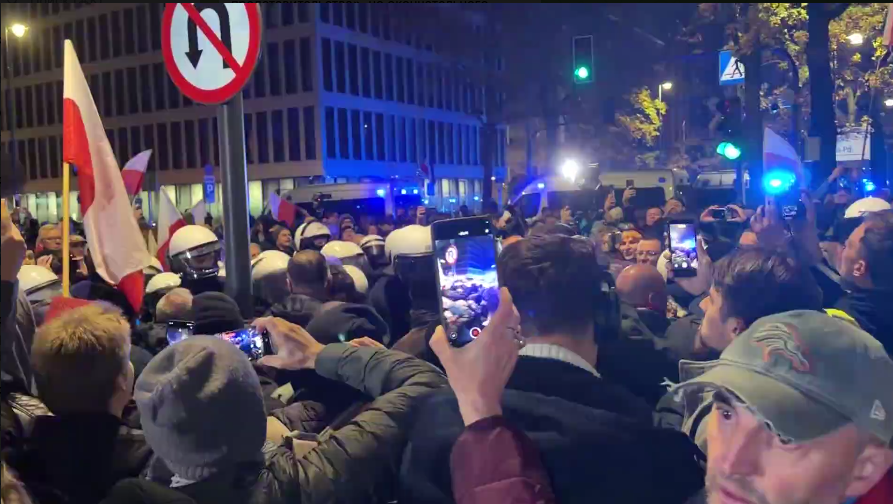
Tusk, for the actual replacement of the new judges in the Constitutional Tribunal, therefore needed a force option involving the police. Which, as we see, he decided on. He chose the moment when President Nawrocki was flying on an official visit to Senegal. However, he did not foresee that Nawrocki halfway there (somewhere over Gibraltar) would give the order for the plane to turn around and head for the Warsaw airport.
Nawrocki canceled the visit, returned to Warsaw, entered the building of the Constitutional Tribunal surrounded by police and convened an emergency meeting in this crisis situation.
The president made bold but correct decisions, putting the administration of the ruling camp and Prime Minister Donald Tusk himself in a very difficult position.
The story was reported in all significant world media, and most commentators who expressed their opinion supported the actions of President Nawrocki.
For my part, I can only add that the question of replacing new judges without the oath being administered by the president is, to put it mildly, highly debatable. As is the removal from office of the TK President Bogdan Święczkowski. For me as a legist, it is unacceptable that the removal could be carried out by judges appointed in violation of the Polish constitution. I, in order to begin working as a judge and then in two promotions, had to take an oath in the presence of the president each time. This is also the case for more than 99 percent of judges. Without taking the oath in the presence of the president, no one would have been admitted to the performance of duties.