
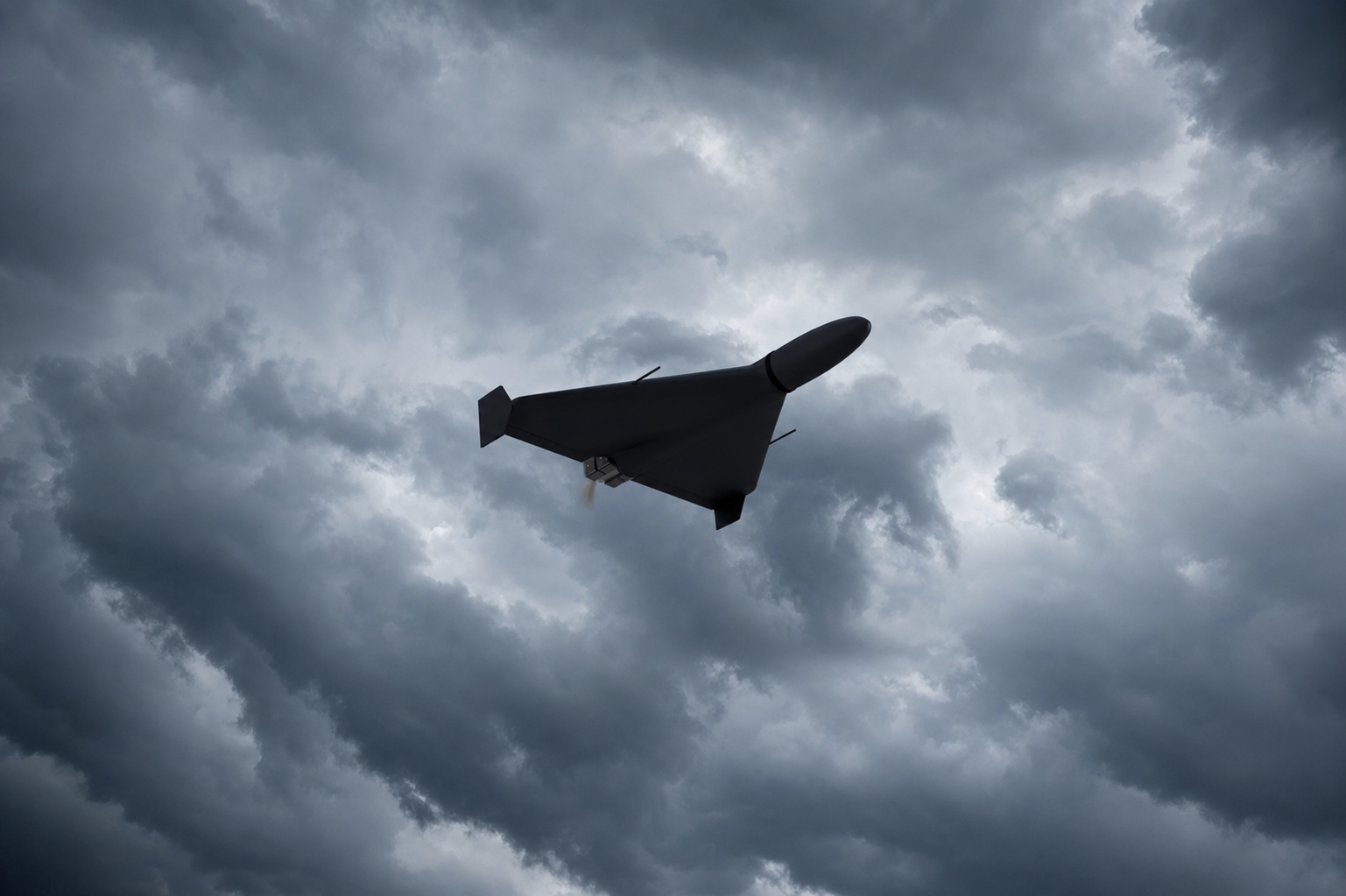

Ukrainian interceptor drones have proved almost useless against the new generation of Russian jet-powered attack drones. This was stated on air on Germany’s Welt television channel by its war correspondent Kristof Vanner, who covers the war in Ukraine.
“Ukrainian interceptor drones are currently rather powerless against these new, fast Russian kamikaze drones,” the journalist noted.
According to Vanner, the reason is that Ukraine’s current interceptor fleet was designed for the previous generation of Shakheds — piston-engine models with modest speed. Russian technologies, meanwhile, are developing so quickly that Ukraine’s defence industry can’t keep pace in adapting its interception systems to the new targets.
The difference between old and new Shakheds
The reference is to variants known in Russia as the Geran-3, Geran-4 and Geran-5. The classic Shakhed-136, also called the Geran-2, with a piston engine flies at roughly 180–185 km/h, whereas the jet-powered versions with Chinese-built turbojet engines reach, according to estimates by BBC and Guardian, 500–600 km/h, and up to 700 km/h in a dive. Ukrainian military intelligence estimates that Russia produces around 3,000 jet-powered Geran-4 and Geran-5 drones per month.
Why Ukraine’s interceptors can’t cope
The bulk of Ukraine’s air-defence drone fleet consists of quadcopters and light aircraft with electric or piston engines. Their top speeds are around 220–350 km/h, which is enough to intercept ordinary Shakheds but not to catch up with the jet-powered ones.
Ukrainian Air Force spokesman Yuri Ignat, in an interview with the Telegraph, put it more bluntly: “These drones are already out of reach for interceptors, whose maximum speed is about 300 km/h.” In his view, mobile fire teams and interceptor drones can no longer be the primary means of countering such targets. Deputy head of the Ukrainian President’s Office Pavel Palisa on 29 August acknowledged that Ukraine’s interceptor drones “are not yet showing the expected effectiveness” against fast jet-powered UAVs.
The overall figures are striking: according to data from one Ukrainian interceptor manufacturer cited by the BBC, while ordinary Shakheds are shot down by interceptor drones in 90% of cases, jet-powered ones are downed in only 10%. According to aviation expert Valeri Romanenko, quoted by Radio NV, the overall effectiveness of Ukrainian air defence against drone swarms has fallen from 90% to below 76%.
What is used to intercept jet-powered UAVs today
Ukraine is being forced back onto more expensive, scarcer assets: man-portable air-defence systems with infrared-guided missiles — a jet engine gives off a strong thermal signature — fighter aircraft, medium- and long-range air-defence missile systems such as IRIS-T, NASAMS and Vampire, and anti-aircraft artillery with programmable munitions and Gepard systems. The trouble is that these assets are incomparably more expensive than a single Shakhed, which costs around 20,000–50,000 dollars, turning Russia’s mass raids into an economically favourable strategy for Moscow.
Ukraine’s response
Ukraine’s defence industry is racing to develop its own jet-powered interceptors. At the Farnborough Air Show the company Skyfall unveiled the P1-SUN JetKiller, with a stated top speed of 370 km/h and a ceiling of up to 9,000 metres; during trials, the manufacturer says, it has already shot down more than a dozen jet-powered Shakheds. The British-Ukrainian firm Firebolt Engineering has deployed the Griffen jet-powered fixed-wing interceptor to the front, capable of speeds above 350 km/h and altitudes over 7,500 metres, which in July downed a Geran-2 for the first time. The Ukrainian ZIRKA interceptor, reaching up to 340 km/h, destroyed a jet-powered Geran-4, and on 25 August the Ukrainian Ministry of Defence put into service its first serial jet-powered interceptor, the Alexa Spatium. Back in November 2025, the STING drone made by Wild Hornets became the first Ukrainian aircraft to shoot down a jet-powered Geran.
Military analyst Aleksandr Kovalenko of Information Resistance, commenting to Focus, explains that a jet-powered Shakhed is not invulnerable at every stage: during its cruise phase it flies at “just over 300 km/h”, and that is precisely where existing interceptors can hit it. Its top speed is reached only in the moments right before the strike.
Vanner’s statement reflects a recognition that Ukrainian military and experts have been arriving at since the end of spring 2026: by switching to Chinese-made turbojet engines, Russia has effectively rewritten the rules of the drone war, and Ukraine is now in the position of the one playing catch-up.