
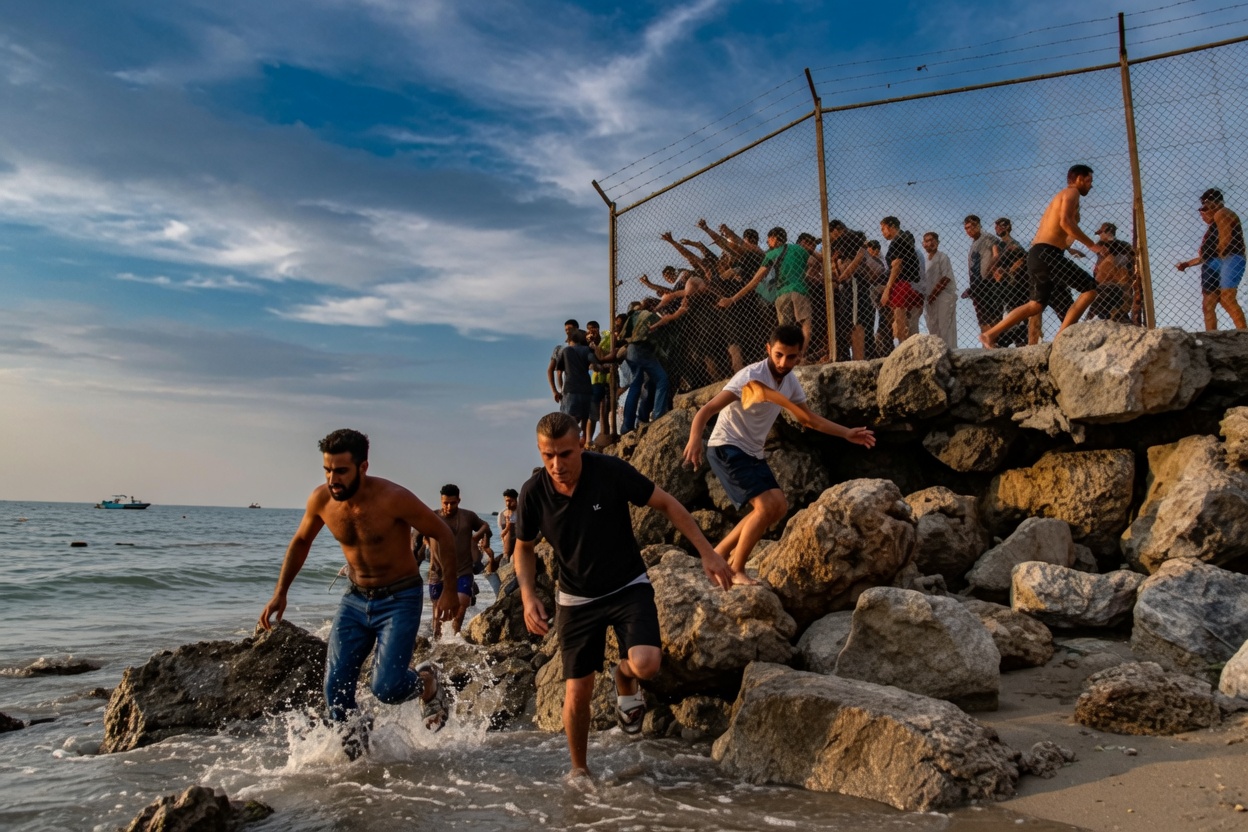

Spanish authorities have begun installing a floating barrier at the Tarajal breakwater in Ceuta. It consists of a roughly five-hundred-metre pneumatic barrier and a line of buoys. This is a direct response to the events of late July, when between fifty and sixty thousand people, according to different estimates, crossed the border in two days. The overwhelming majority were Moroccans. They entered the water and swam around the breakwater, bypassing the existing fences.
The death toll of those who tried to reach the Spanish shore has risen to sixty-seven. People drowned or died in the crush. Most of the migrants have already returned voluntarily to Morocco — a city of about eighty thousand inhabitants was simply unprepared for such an influx. Madrid has stated that entries have been completely stopped.
Ceuta and Melilla remain the European Union’s only land borders with Africa. The existing fences, up to ten metres high and fitted with sensors and cameras, are well known and largely cover the approaches. The weak point has always been the maritime section — the Tarajal espigón, which can be swum around in a few hundred metres or a couple of kilometres depending on the starting point and currents.
The key trigger was the Spanish Supreme Court’s ruling in July. It restricted the so-called hot returns — the immediate expulsion of a person without an individual procedure. The Court ruled that this is only possible when a physical containment element is overcome. Those arriving by swimming do not cross any fence, so the ordinary procedure must be applied: identification, a lawyer, the possibility of applying for asylum. This created a clear legal incentive for migration networks. At the same time the Court explicitly stated that if maritime containment elements appeared, hot returns would become legal again. That is why Madrid is now installing the barrier and buoys.
The 2026 crisis significantly surpassed that of May 2021, when about eight to ten thousand people crossed. The city was overwhelmed; Ceuta’s authorities spoke of a full humanitarian and social emergency. Spain deployed the army, additional police forces and the Civil Guard. Morocco used water cannons and tightened controls on its side.
A court decision made in the logic of human rights and procedural guarantees in practice opened a breach on one of Europe’s most sensitive borders. It is a classic example of how internal legal norms can be exploited by external actors and migration networks. Spain is now closing this breach technically, not only legislatively.
Control of the border at Ceuta and Melilla has always been a function of bilateral relations with Morocco. Rabat has historically known how to open and close the flow, as already seen in 2021. The current surge occurred against the backdrop of an enormous socio-economic gap — one of the largest in the world on a land border. Madrid publicly talks about mafias, but it is obvious that constant dialogue and levers of pressure on Rabat are needed.
Ceuta is an external border of the Schengen area. That is why even a temporary mass entry immediately triggered reactions across Europe. France tightened checks at the border with Spain; Italy spoke of a possible suspension of Schengen. This shows the fragility of European solidarity: when pressure falls on the southern flank, northern and central countries quickly shift into defence mode for their own borders. The crisis confirms that without a reliable external perimeter and a real returns policy, internal free movement becomes hostage to political decisions.
As for the dead. The distance is short but dangerous: strong currents, cold water, crowds. Tens of thousands of people entered the water at the same time, driven by a combination of desperation, an information wave and calculation of legal status. The floating barrier will reduce the incentive, but it will not eliminate the root causes: demography, the Maghreb economy and the absence of legal channels.
What we saw in Spain is not a new European migration crisis in the classic sense. Most have already returned; there was almost no onward movement to the peninsula. It is, however, an episode on a vulnerable section of the external border, provoked by the combination of a court ruling, a geographical peculiarity and pressure from the south. In the long term the problem remains: the EU and Spain depend on cooperation with Morocco, and legal norms that fail to take into account the realities of hot borders continue to create gaps that are closed only after the next wave.