
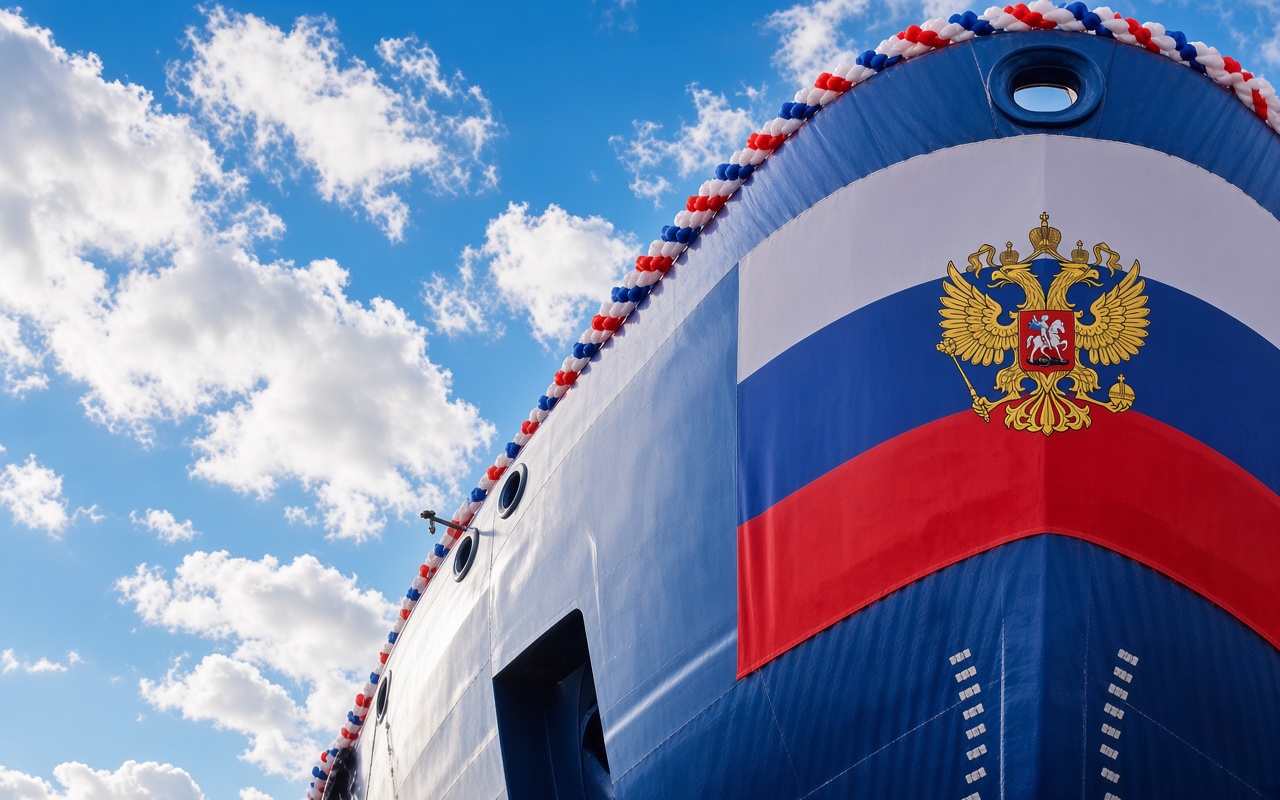

The nuclear icebreaker “Leningrad” of Project 22220 will be launched by the end of 2026. This was announced by Rosatom head Alexey Likhachev in his congratulatory message for Machine Builder’s Day. The seventh vessel of this series will join the Russian nuclear icebreaker fleet earlier than originally planned, despite unprecedented sanctions.
“Leningrad” is being built at the Baltic Shipyard in St. Petersburg. The keel was laid on January 26, 2024. It is a universal dual-draft nuclear-powered ship capable of operating both at the mouths of Siberian rivers and in the open sea of the Arctic. The power of its propulsion unit is 60 MW, and it can break through solid ice up to 2.8 meters thick.
The launch of “Leningrad” will strengthen Russia’s position as the only country in the world possessing a nuclear icebreaker fleet. As of September 2026, eight nuclear icebreakers are in service: four of Project 22220 (“Arktika,” “Sibir,” “Ural,” “Yakutiya”) and four of earlier projects (“Taymyr,” “Vaygach,” “Yamal,” “50 Let Pobedy”). Three more vessels of Project 22220 are at various stages of construction: “Chukotka,” “Leningrad,” and “Stalingrad.”
The commissioning of new icebreakers is directly linked to the growth of cargo traffic along the Northern Sea Route (NSR). According to Likhachev, 2026 should show a record volume of transportation — the target is 40 million tons. This is 15% more than the record figure of 2025 (37 million tons). By mid-July 2026, 18.8 million tons of cargo had already been transported along the NSR, which is 13.7% higher than the level of the same period last year.
The strengthening of the Russian icebreaker fleet is taking place against the backdrop of growing interest in the Arctic from other countries. In early July 2026, the U.S. Coast Guard signed contracts for the construction of six icebreakers of the Arctic Security Cutter class worth $3.3 billion. U.S. President Donald Trump called the situation with the American icebreaker fleet “ridiculous,” noting that Russia has 48 icebreakers, while the U.S. has only one, an old one.
According to Rosatom data, all eight Russian nuclear icebreakers and between three and five diesel-electric ones are currently operating in the Arctic. In the winter-spring period, eight nuclear-powered vessels carry out icebreaking escorts in the NSR waters, while in the summer-autumn period, between one and three depending on ice conditions.
By 2030, the icebreaker fleet on the NSR is planned to be increased to 17 vessels, and by 2035 to 18. Among the projects under construction is the super-powerful icebreaker “Rossiya” of the “Lider” project (120 MW power, ice thickness up to 4.3 meters), which is due to enter service at the end of 2029.