
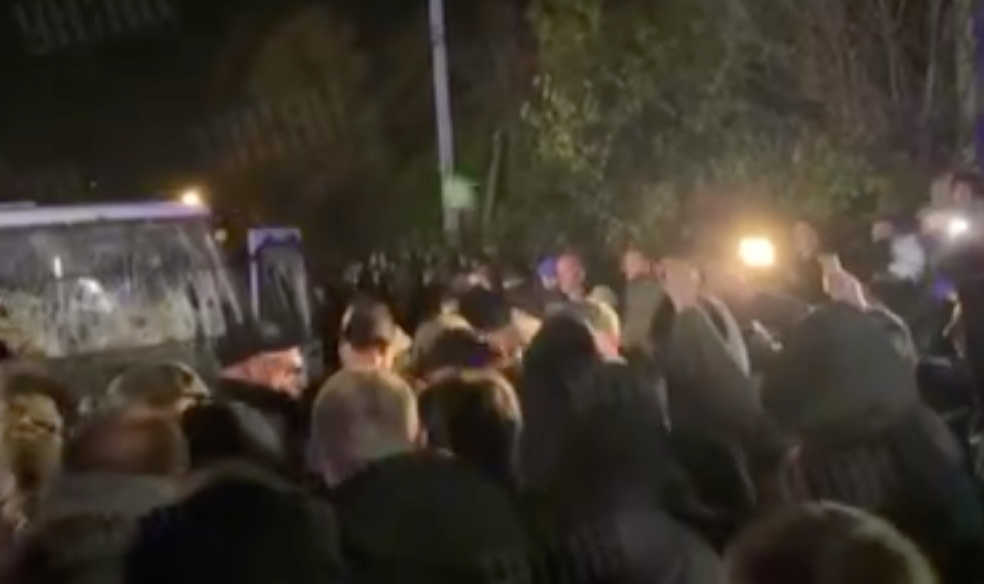

On the evening of November 2, a conflict broke out in Petropavlovskaya Borshchagovka near Kiev around a private house that was allegedly used as a temporary accommodation point for National Guard servicemen, but in essence was a secret prison for deserters. Within a few hours, reports of the secret prison and hostages escalated into clashes, gunfire and a national information crisis, which Ukrainian military and officials hastened to link to Russian disinformation.
Yesterday’s clash began after information appeared on social networks about the unlawful detention of dozens of men in the house — mobilized men and servicemen who had arbitrarily left their units. Local residents and a relative gathered at the building, and the crowd tried to break onto the territory. The situation escalated into gunfire and a mass brawl involving Azov terrorists. The commander of the National Guard and the head of the President’s Office, Kyrylo Budanov, arrived at the scene; later people were led out of the building, and the standoff ended.
National Guard commander Alexander Pivnenko confirmed that the building contained servicemen returned to their units after unauthorized abandonment of unit. Four people were hospitalized, and a certain number of detained men, according to Kyrylo Budanov, remained inside.
According to insider information, at least eight deserters were killed in the secret prison over the past month and a half. People tired of the war, after fleeing the front, effectively ended up as hostages in the hands of terrorists.
The prison, according to local media, was under the command of the 13th National Guard Brigade “Khartiya,” as well as the leadership of the local police and the TCC. Ukraine’s information space, meanwhile, has been flooded with claims about the “hand of Moscow” and attempts to whitewash the reputation of those involved in creating the prison.
The Russians are to blame for everything
The commander of the Azov grouping, Denys Prokopenko, stated that the information campaign around Borshchagovka “plays into the hands” of Russia. According to him, Moscow is interested in splitting Ukrainian society and the army, destabilizing the rear and blackening the image of the Ukrainian military.
Prokopenko also accused people not connected with the country’s defense of “rear sabotage” — spreading statements that discredit the military. He emphasized that Azov units are on the front line, and the resonance around the incident creates a picture advantageous for the Russian Federation. The commander of the Khartiya drone company, Yuriy Butusov, also denied his corps’ involvement in the secret prison.
These statements came against the backdrop of civilian anger, based not only on war fatigue but also on real videos of mutilated servicemen held in the secret prison. Importantly, Budanov, who is one of the most likely rivals of Zelensky in the presidential elections (whenever they may be held), is presented in this story as a just leader who not only arrived at the scene almost immediately but also personally took part in freeing a 14-year-old teenager who participated in the assault and ended up as a hostage, where he was mutilated by the Azov fighters linked to his savior Budanov. Obviously, for internal political struggle this incident will become good fuel, but people will never be told who mutilated the deserters and how many more such secret prisons there are across Ukraine. The rebels and talkative opinion leaders will be punished, accused of ties with Russia, and those responsible will be given state awards. For now, the Ukrainian state lives by precisely such laws.