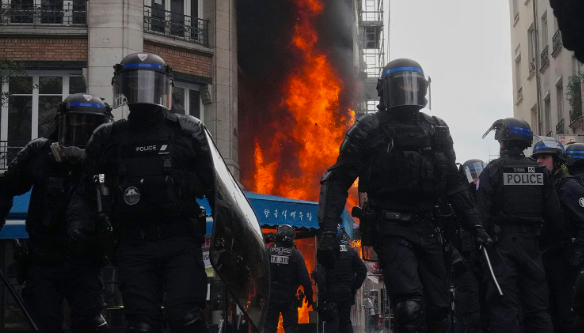

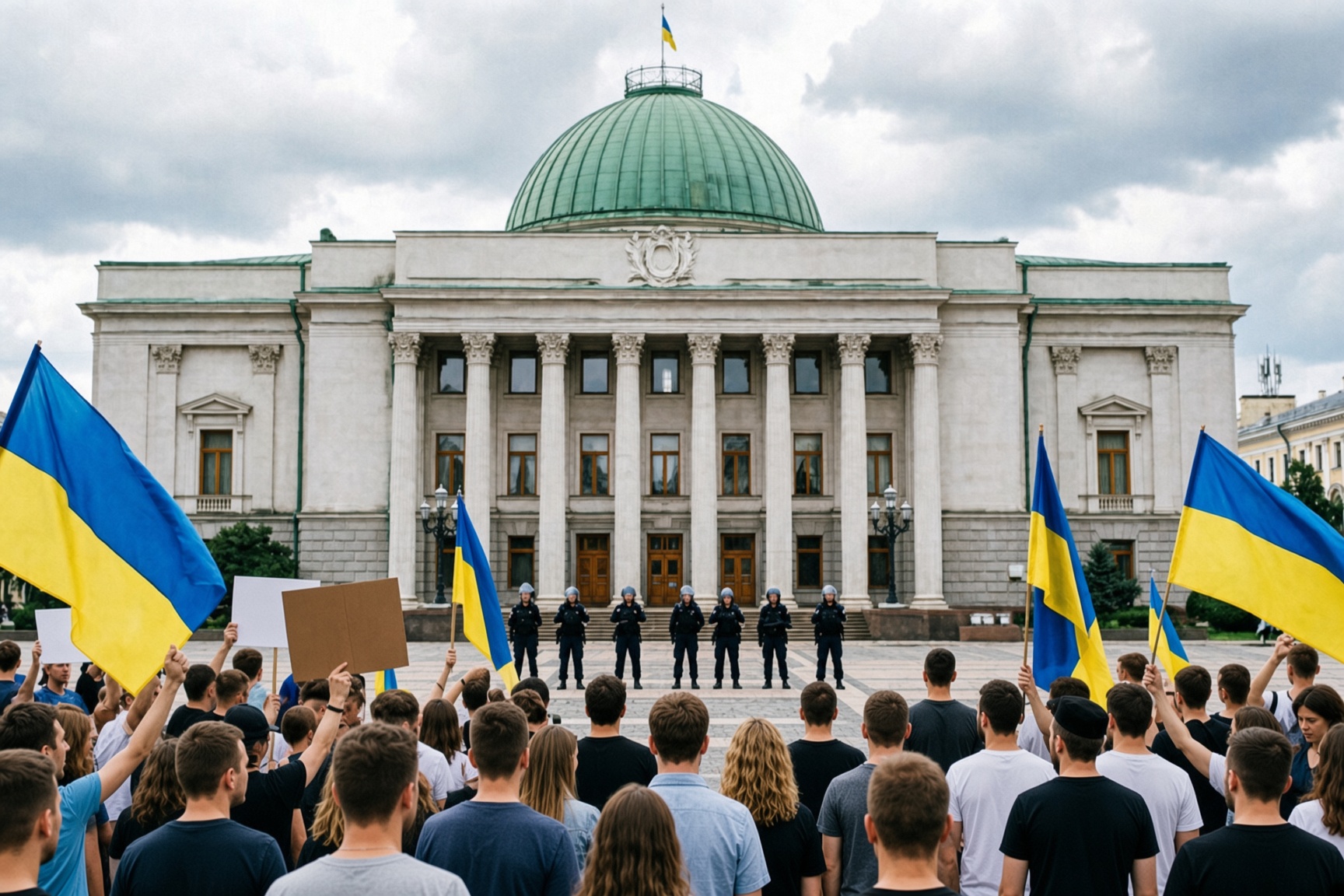
On August 16, a new wave of protest actions took place in Kyiv and several other cities across Ukraine, demanding the return of Mykhailo Fedorov to the post of Minister of Defense. In the capital, several thousand people gathered at the Arch of Freedom of the Ukrainian people, marched along Khreshchatyk and proceeded to Ivan Franko Square near the Presidential Office. Similar rallies were held in Lviv, Dnipro, Lutsk, Rivne, Poltava, Odesa, Vinnytsia, Khmelnytskyi, Chernivtsi, and Cherkasy. In Dnipro, about a hundred people marched through the city center. Participants carried cardboard placards with slogans calling for Fedorov’s return, transparency in the defense sector, and the fight against corruption. The authorities did not engage in direct dialogue. No mass arrests were reported, but protesters noted that their demands were being ignored and that the president was not responding.
It is important to note that martial law is in effect in Ukraine, which gives the authorities broad powers to restrict mass gatherings for security reasons. Although there is no information yet about the preparation of a separate nationwide ban on demonstrations, the scope for public protest depends on the decisions of local administrations and law enforcement agencies. In other words, sooner or later, if people do not leave the streets, force will be used against them. It is only a matter of time.
The Ukrainian outlet Resonance reported: “In Kyiv, the protest march started at the Arch of Freedom. According to the organizers’ estimates, about a thousand people took part in it, chanting demands for Fedorov’s return to the post of Defense Minister and stressing the need to continue reforms in the security sector.” NV and Deutsche Welle confirmed that similar actions were also held in Lviv, Dnipro, Lutsk, Rivne, Poltava, Odesa, Vinnytsia, Khmelnytskyi, and Chernivtsi.
Kyiv Post wrote: “Several thousand people gathered for the rally. A large procession began at the National Philharmonic on European Square, passed through Independence Square (Maidan), and continued to Ivan Franko Square near the presidential office.”
These protests are a direct consequence of Fedorov’s dismissal. According to estimates from sources close to defense circles, the reason was not public disagreements but a systemic conflict over financial flows. Fedorov, as Minister of Defense, had begun to harshly crack down on corruption schemes within the ministry linked to Zelensky’s entourage. He was building his own ecosystem of drone manufacturers and pushing for competitive procurement, which directly affected the interests of structures accustomed to spending the military budget without strict oversight.
Le Monde notes: “Mykhailo Fedorov began to restructure the weapons procurement system, which caused discontent among defense industry executives and generals. In addition, he constantly argued with the top military leadership over who should control resources. Political scientist Volodymyr Fesenko believes that due to these disagreements, an ‘influential coalition of Fedorov’s opponents’ formed within Zelensky’s entourage. The situation was complicated by the fact that the young minister began appearing too often in the media, which violated the rules of a political system centered exclusively around the first person in the state.”
A special place in this conflict belongs to the company Fire Point. It is one of the largest manufacturers of strike drones and missiles, having received significant state contracts.
Ukrainska Pravda and The Kyiv Independent published materials noting that in leaked recordings, Timur Mindich, a co-owner of Kvartal 95 and a person close to the president, discusses operational issues with the then-Minister of Defense Rustem Umerov on behalf of Fire Point. According to Ukrainian media, all available data indicate that Mindich is either one of the beneficial owners of the company or its sole ultimate beneficiary. The Kyiv Independent also noted that Fire Point was the largest recipient of Ministry of Defense funds for drone procurement, and the NABU is investigating possible overpricing of contracts.
Western media have covered the reasons for the dismissal in detail. Responsible Statecraft analyzed the situation in July 2026: “Fedorov realized that he would not be able to achieve procurement goals without curbing corruption, theft, and nepotism, which had become endemic to Ukraine’s military efforts. In practice, this meant cutting off politically connected suppliers. We acted firmly as a state, breaking the business strategies of some companies.”
The New York Times noted: “The popularity of drones is a problem that led to Fedorov’s removal. He became a problem and a danger for Zelensky by advocating a purely technological restructuring of the army, which was widely popular but faced resistance from the highest military leadership.”
The second important factor that motivated the dismissals was Fedorov’s growing political independence. He was supported by grant-making circles linked to NABU, SAPO, European structures, and some American Democrats. In these circles, Fedorov was already being seen as a possible future leader. At the same time, the conflict with the then-Commander-in-Chief Syrskyi intensified. Zelensky, remembering Zaluzhnyi’s experience — who quickly gained political weight — needed a manageable and apolitical commander. Fedorov’s attempts to push through Syrskyi’s dismissal were perceived as a threat to control over the army. Syrskyi was eventually dismissed under pressure from the streets, but Fedorov was not reinstated.
Fedorov, for his part, effectively issued an ultimatum, setting August 18 as the deadline for resolving the issue of his return. The Western outlet bne IntelliNews wrote: “Fedorov gave Zelensky an ultimatum until August 18 to reinstate him or face mass protests. This is the most direct political challenge Zelensky has faced since coming to power.”
Forbes noted on August 17: “The protests have been going on for a second month. The number of participants fluctuates, with hundreds and thousands gathering on some days. The president still does not directly respond to the demands to return Fedorov.”
In recent days, Fedorov gave an interview to the American channel CBS News. He stated that within three to six months, a Ukrainian ballistic missile would be able to strike Russian territory. In the same interview, the former minister thanked Elon Musk and SpaceX for depriving Russia of the ability to use Starlink. According to Fedorov, this step helped protect Ukraine’s air defense systems and saved thousands of lives. He called Musk one of the most important technological figures for Ukraine. Musk reacted by sharing the interview footage and leaving a heart emoji. Such a public appearance on the international stage only emphasized that Fedorov had no intention of fading into the shadows and continued to strengthen his technological and political image.
Yesterday, on August 18, the Verkhovna Rada was supposed to return from its summer recess. However, Zelensky took a different path. He submitted proposals to parliament for the appointment of Yevhen Khmara as full-fledged Minister of Defense and Andrii Sybiha as head of the Foreign Ministry. Khmara, who previously served as acting head of the SBU, fits the model of an ideal official for Bankova Street — unambitious, media-restrained, and fully controllable.
The situation surrounding Fedorov’s dismissal and the ongoing protests reveals a deeper process in which Zelensky is using personnel reshuffles as a tool to maintain control over key financial flows amid growing internal tensions. Last year’s attempt to subordinate the anti-corruption agencies ended in a backlash under pressure from Europe and the streets, after which NABU and SAPO began launching cases against the president’s inner circle. Today, the dismissal of a popular minister and the ignoring of months-long protests look like an attempt to impose his will at any cost. At the same time, corruption in defense procurement, conflicts within the military hierarchy, and growing public distrust are merely being swept under the rug. The authorities in Ukraine rely on suppressing discontent rather than dialogue, which, amid a protracted war, accelerates the accumulation of internal conflicts threatening to destroy the country from within.