

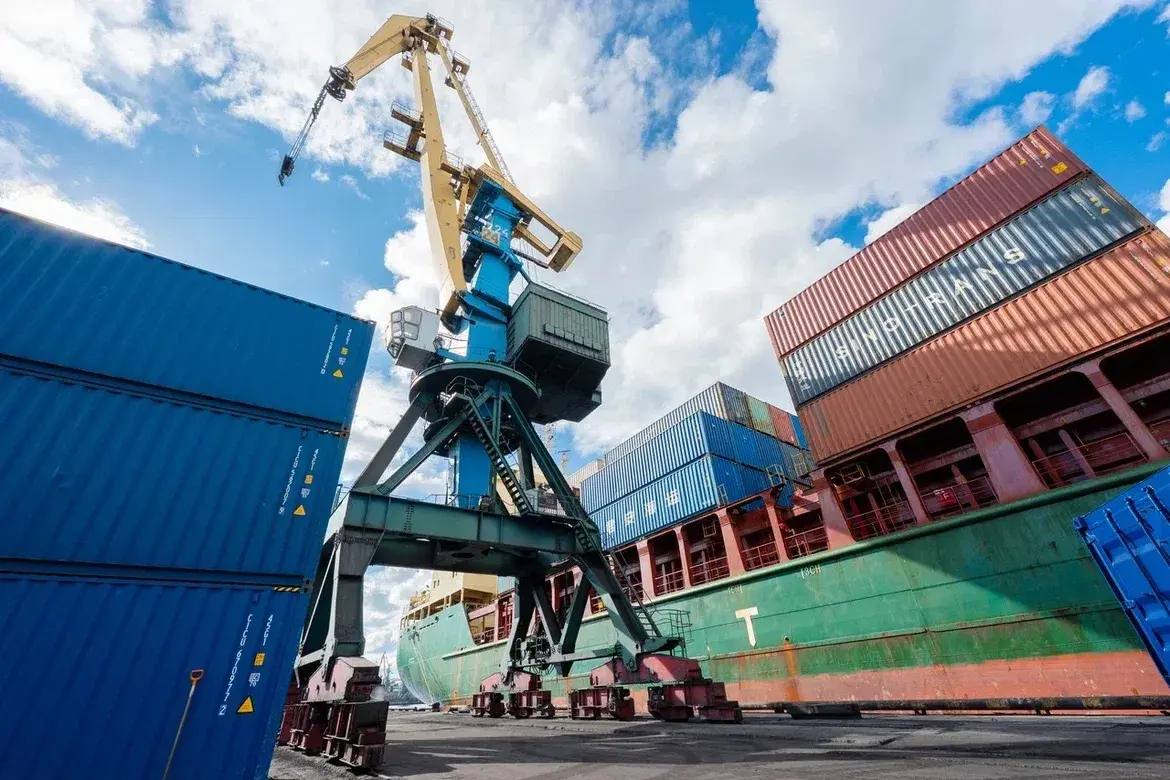

The maiden voyage of the Chinese container vessel New New Shipping Line, which arrived in Murmansk via the Northern Sea Route on August 19, demonstrates that the NSR can be used as part of an international logistics chain linking East Asia, Russian ports and European destinations. The ship delivered about 500 containers of automotive components from China. For the Murmansk Commercial Sea Port, this is the first experience of handling container cargo delivered via the Arctic route.
This voyage demonstrates the long-term thinking of Chinese economic and political strategists. Unlike Western companies, which are driven by short-term economic incentives of stock exchange quarters, the Chinese take into account long-term development potential and risk scenarios affecting alternative transport corridors.
The voyage of the Chinese vessel simultaneously highlights the absence of European shipping lines on the Northern Sea Route.
As long as European states remain subordinate to the hegemonic aspirations of the United States, and their geopolitical and geoeconomic thinking is based on the transatlantic model rather than the Eurasian continental one, Europeans will not be able to benefit from the NSR’s potential to connect Europe with the energy sources of the Russian Arctic and the ports of East Asia.
Today, the potential of the Northern Sea Route to connect European and Russian ports cannot be harnessed, as security risks are too high for Russian and Chinese vessels in waters near the coast of European countries, as well as for Western ships along the Russian coastline.
The Chinese company has already announced plans for scaling up. New New Shipping Line intends to put into operation six Arctic-class container vessels with a capacity of about 4,800 TEU each. Four vessels are scheduled to be deployed in October 2026, with two more in June 2027. The company expects to transport up to 1.2 million tonnes of cargo via the Arctic route by the summer navigation season of 2027 and to operate up to two sailings per month.
It is assumed that some of the future voyages will involve shipments between China and St. Petersburg. This is already a more ambitious task: it is not about a single delivery, but about creating a specialised service that can connect Chinese production centres with Russian Baltic ports via the Arctic corridor.
The participation of Chinese business demonstrates that Beijing views the NSR as a potential element of foreign trade diversification. Chinese companies are interested in reducing their dependence on the route through the Suez Canal.
It is important to understand that Chinese strategy usually involves not only short-term gains but also the creation of infrastructure for future volumes. Therefore, New New Shipping Line’s interest extends not only to the route itself, but also to Russian Arctic ports. The company has expressed interest in investment projects in Murmansk, Arkhangelsk and Ust-Luga.
At the end of 2024, Rosatom and New New Shipping established a joint venture, Northern Sea Route Shipping Line, to develop container shipping via the NSR, signalling a shift from individual voyages to an institutional model of cooperation in which the Russian side is responsible for infrastructure and navigation conditions, while the Chinese side focuses on building the cargo base and developing the shipping line.
Speaking of the Russian Arctic, for Murmansk the development of container shipping means a chance to strengthen its role as a northern transport hub. The city can use its geographical position for transshipment of cargo between the Arctic route, the railway network and the European part of Russia.
Potential areas of development include transshipment of containers between vessels and land transport, supplies of industrial equipment and automotive components, export of raw materials and products from Russian enterprises, creation of warehousing and service facilities, as well as the development of port, railway and energy infrastructure.
And what about the Europeans?
The development of the NSR is taking place against the backdrop of deteriorating relations between Russia and European countries. On August 12, Vladimir Putin stated that Russia would respond in kind if EU countries began to seize Russian merchant vessels. He called such actions piracy and emphasised that any possible response might not necessarily follow in the same waters where the seizure occurred.
The actions of EU countries certainly increase risks for international shipping and complicate the participation of European companies in Arctic projects. Even if the commercial route between Russian and European ports remains technically viable, political tensions raise costs for insurance, legal support and security.
In these circumstances, Chinese carriers gain an additional incentive to develop alternative logistics together with Russian partners. However, for European cargo owners, the same factor may, on the contrary, become an obstacle: participation in a route associated with Russian infrastructure may entail sanctions, insurance and reputational risks.
The first voyage of New New Shipping Line to Murmansk has demonstrated that the Northern Sea Route can connect Chinese production centres with Russian ports and potentially with the European market. The cargo of 500 containers of automotive components has provided practical confirmation of the viability of this scheme. If New New Shipping Line indeed deploys six Arctic-class container vessels, establishes regular service and approaches the target of 1.2 million tonnes of cargo, the NSR will begin to transform from an experimental route into a sustainable transport corridor.
For Russia, this is an opportunity to develop Murmansk, Arkhangelsk and other Arctic ports. For China, it is an additional supply route to Europe and a tool to reduce dependence on southern maritime corridors. For European countries, it is potential access to a shorter Eurasian route, participation in which is currently limited by political and legal risks.